18.13 FOCE-I and ETA–EPS interaction
FOCE-I uses the conditional mode for both prediction linearization and residual variance. “Interaction” means the residual-error magnitude may change with ETA through the individual prediction; it does not mean estimating statistical covariance between ETA and EPS, which remain independent in the standard model.
For proportional error, \(V(\eta)=\sigma^2Y(\eta)^2\). A subject with larger ETA-driven prediction has larger conditional residual variance. FOCE evaluates (V(0)); FOCE-I evaluates \(V(\hat\eta_i)\). The mode itself is also found using the ETA-dependent variance.
FOCE-I corresponds to METHOD=1 INTERACTION and is nlmx’s default classical screen approximation. It often improves approximation for proportional/combined error but costs the same general class of nested optimization as FOCE.
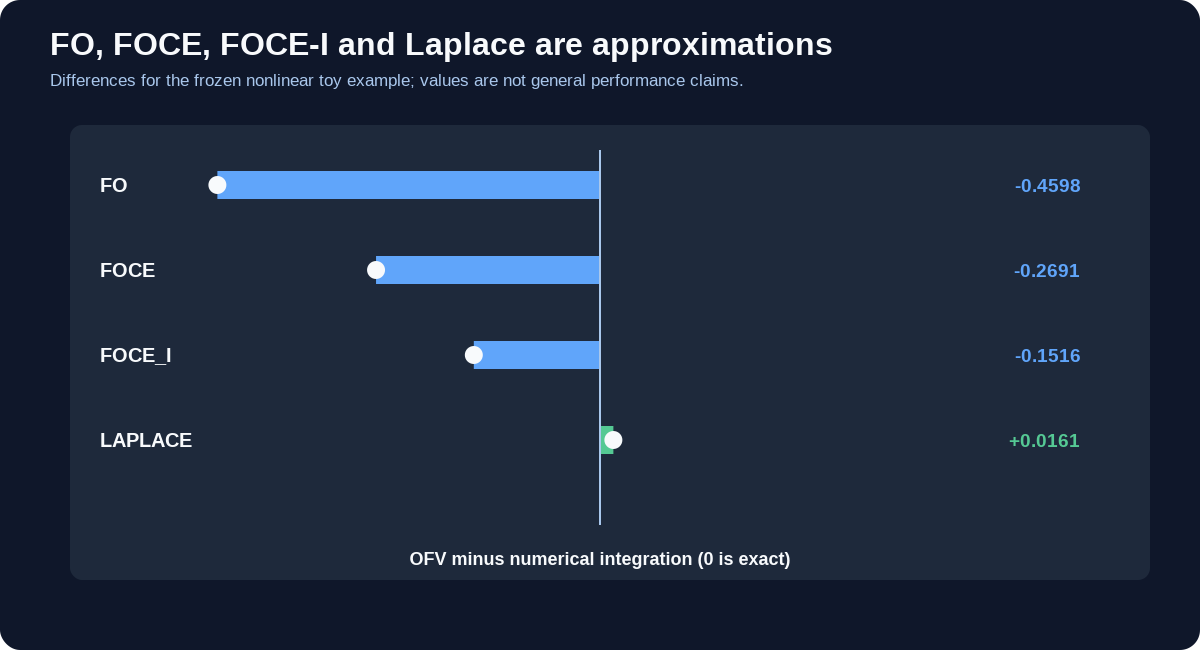
The frozen nonlinear example deliberately uses ETA-dependent combined variance. It produces different FOCE and FOCE-I modes, making interaction visible. This single example illustrates mechanics, not a universal accuracy ranking.
Practical interpretation
Write the residual SD at ETA zero and at the final EBE for a low- and high-prediction subject. If the values differ materially, interaction affects both weighting and mode location. This exercise also prevents a common verbal error: the ETAs and EPS remain probabilistically independent, while the magnitude multiplying EPS changes because the prediction depends on ETA.
For review, state whether the implemented residual equation creates interaction and identify the exact variance evaluation point. A method name without this explanation is insufficient for reproducing the likelihood.
Common mistakes
Do not describe interaction as ETA–EPS correlation, compare FOCE and FOCE-I OFVs as if only optimizer settings changed, or assume interaction matters with constant additive variance.
Checklist
- Derive \(V(\eta)\) from
$ERROR. - Confirm mode and variance evaluation points.
- Use the exact method label in reports.
- Review zero/very small predictions.
- Validate against aligned reference settings.
Further reading
See residual error, method comparison, and computed approximation errors.