17.4 Route detection, groups, filters, and censoring
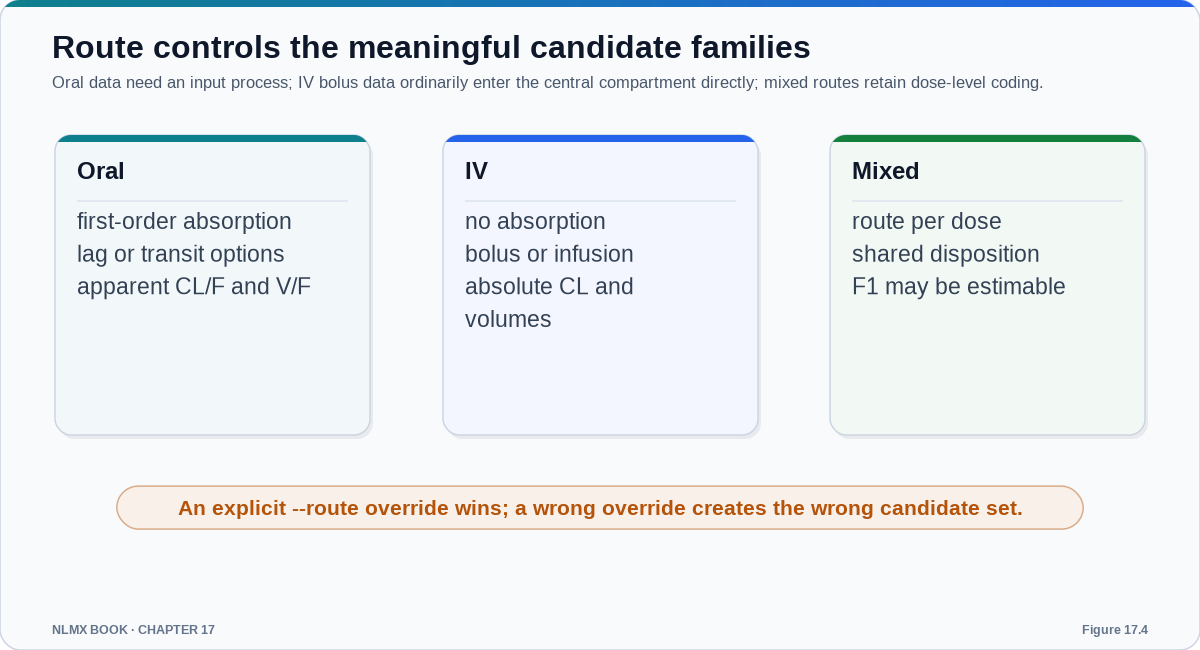
Route determines which candidates are meaningful. IV bolus dosing generally enters the central compartment directly; oral dosing needs an input process; infusion uses duration/rate information; mixed designs retain the route of each dose. screen can infer route from RATE, CMT, profile shape and group evidence, but an explicit --route override wins. Use the override only after verifying it.
--group summarizes regimen strata and can help route interpretation. It does not automatically fit separate population parameters. All included subjects remain in one population fit unless the model explicitly introduces group effects. A useful group label describes design—oral, bolus, infusion, dose level, formulation—rather than an outcome discovered after fitting.
--filter acts on records/population before analysis; --obs-filter restricts observations while retaining event history needed to predict them. This distinction matters: removing dose records can change the regimen, whereas excluding an observation should not erase the dose that caused it. Save the exact expressions and compare counts before and after each filter.
For values below the lower limit of quantification, specify the LLOQ and BLQ convention. “Left out” and likelihood-based censoring are different analyses. If DV is already logarithmic, declare --dv-log; otherwise predictions, error models and LLOQ scale may be wrong. Never apply log transformation twice.
Common mistakes
Common errors are treating GROUP as a covariate model, filtering observations by deleting their preceding doses, coding infusion as bolus, and combining an LLOQ in concentration units with log-scale DV. Route inference can be confident and still wrong when early samples are absent.
Checklist
- Confirm route per dose and group in the summary.
- Audit record and observation filters separately.
- State the BLQ strategy and LLOQ scale.
- Confirm whether DV is raw or logged.
- Re-run data QC after any population change.
Further reading
Candidate consequences appear in candidate hierarchy and input families.