24.28 Selection probability, intervals, sign, form, and agreement
Primary selection probability is the fraction of scheduled primary-learner fits selecting an equation or pair. nlmx reports an interval reflecting finite selection counts. Sign stability is the proportion of selected coefficients sharing the dominant sign. Form stability is the chosen equation's share among pair selections. Algorithm agreement is the fraction of configured learners whose probability reaches the effective threshold.
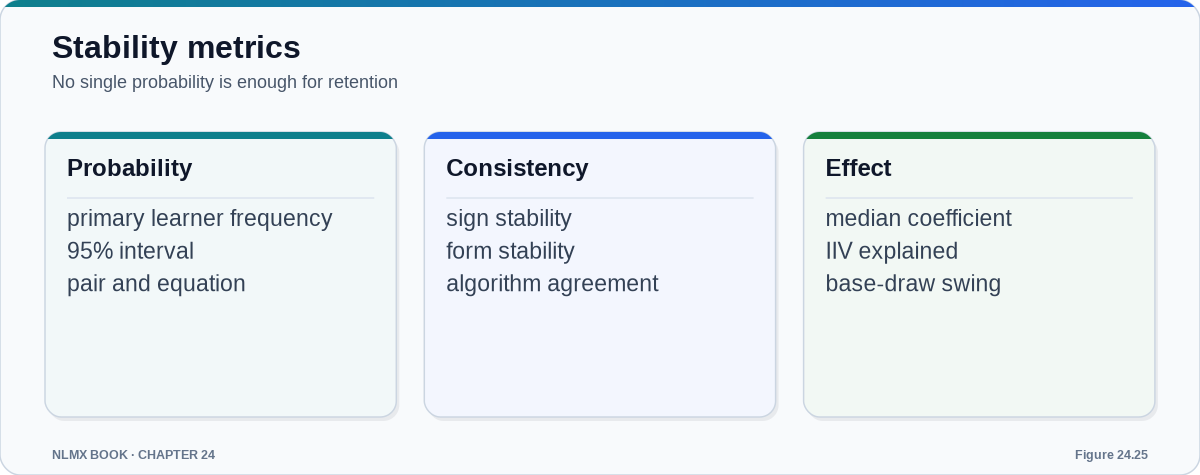
These metrics answer different questions. Probability measures reproducibility; sign stability measures directional consistency conditional on selection; form stability measures equation identity; agreement measures robustness to learner assumptions. A pair can have high probability but fail retention because sign, form, agreement, variance consistency, cluster ambiguity, or base-draw swing fails.
Report denominators and thresholds. A sign of 1.0 based on two selections is not strong evidence.
Common mistakes
- Treating probability as Bayesian inclusion probability.
- Ignoring the probability interval.
- Reading sign stability without selection count.
- Averaging learner probabilities instead of using defined agreement.
- Omitting effective threshold after error control.
Checklist
- Report pair/equation probabilities and intervals.
- Review selection counts behind sign/form metrics.
- List learner-specific probabilities.
- Apply every classification gate.
- Repeat borderline results with more replicates.
Further reading
Continue to pair/form/agreement and classification.