31.29 Saving datasets, threads, and runtime
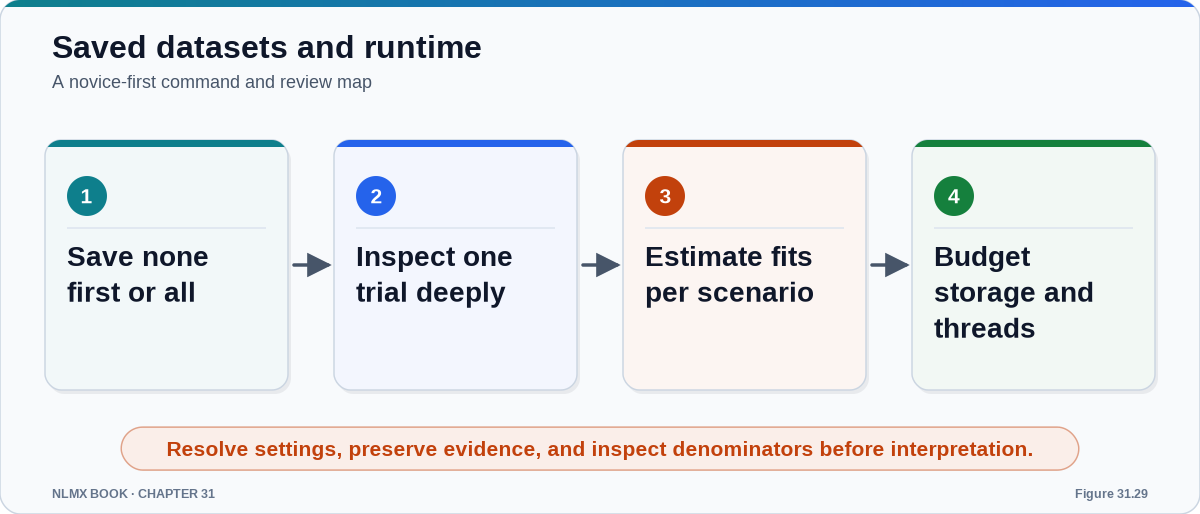
--save-datasets none|first|all retains no simulated datasets, the first alternative and null dataset per scenario, or every dataset. Threads parallelise subjects and replicates without changing results.
What the controls mean
- Storage grows with scenarios × replicates × records.
- Runtime grows with full and reduced fits, covariance work, model complexity, and failures.
- Use first for forensic smoke review and all only with a retention plan.
The issued command is only the beginning of the audit trail. Always distinguish the reference model, the design template, the resolved scenario, the replicate-specific truth, the fitted result, and the test decision. A value can be correct at one layer and misinterpreted at another.
Command or settings pattern
--save-datasets first --threads 8
Command-line values override settings-file values. Use a fresh folder for an analytical run; preserve the command, resolved settings, log, checksums, and row-level data. Defaults are versioned behavior, so a production protocol should state important values explicitly.
Interpretation and quality control
Estimate cost from a smoke run and archive the exact seed/settings needed to regenerate unsaved data.
For a novice review, first confirm counts and labels, then inspect numerical values, then ask whether the assumptions represent the proposed clinical study. For an expert review, additionally reconcile aggregates from row-level output, reproduce a subset of trials, and compare the implementation with an independent reference where the claim requires it.
Common mistakes
- Saving all datasets by default
- Assuming linear speedup at any thread count
- Reporting a point estimate without its denominator, interval, method, and version
Minimum evidence to retain
- nlmx version, command,
.powerfile, resolved settings, seed, threads, and output checksums; - control stream, design dataset, EXT/COV or parameter sets, and their provenance;
- scenario table, replicate rows and failures, method summaries, plots, report, and interpretation;
- prespecified criteria, Monte Carlo target, validation scope, deviations, and reviewer decisions.
Navigation
See the previous page, next page, and complete command and settings index.