13.2 Data requirements and column mapping
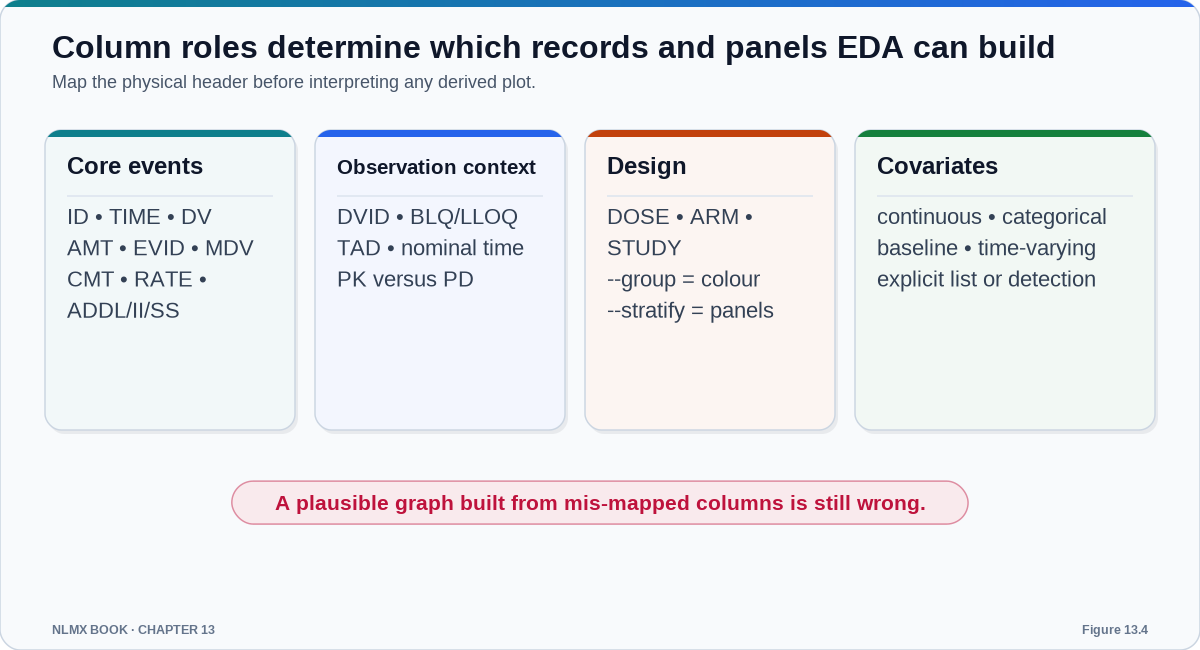
EDA is only as correct as its mapping from physical columns to pharmacometric roles. ID, TIME, and DV must exist. AMT, EVID, MDV, CMT, RATE, ADDL, II, and SS improve dose/event interpretation; common defaults can be replaced with the corresponding --*-col options.
Required versus optional
Without ID, individual profiles and subject summaries cannot be built. Without TIME, longitudinal order is unknown. Without DV, there is no observation value. Dose-related plots require recognizable dose records, usually through EVID/AMT. DVID enables multiple endpoint types; TAD and nominal time can be supplied or, where possible, derived. BLQ can come from a positive scalar LLOQ, a row-specific configuration column, or a nonzero flag.
Names are case-insensitive in the checked reader, but position, values, and meaning still matter. --dv-col CONC says CONC is the observation; it does not confirm units or whether the values are logged. If DV is natural-log concentration, declare --dv-log and ensure later plots are interpreted on the correct scale.
Automatic optional-column discovery
When not explicitly set, eda looks for DVID-like names (DVID, YTYPE, TYPE, DVTYPE), BLQ-like names (BLQ, BQL, BLOQ, CENS), and nominal-time names such as NTIM, NTIME, NOMTIME, NOMT, TNOM, or NT. Discovery is a convenience, not an approval. Record the chosen column in the summary and compare it with the data specification.
A mapping ledger
Create a table with physical header, EDA role, units, allowed values, missing convention, and source specification. Review dose and observation examples line by line. If QC and EDA use different mappings, their counts will not be comparable.
Common mistakes
- Mapping scheduled time as actual TIME without documenting it.
- Treating CMT as DVID or vice versa.
- Declaring log DV but labeling axes in original concentration units.
- Assuming inferred EVID/MDV matches all downstream software.
Checklist
- Verify ID, TIME, DV, and event columns against specifications.
- Confirm optional auto-discovery explicitly.
- Record units and transformations.
- Compare dose, observation, and subject counts with QC.
- Inspect several real rows for every role.
Further reading
See dataset mapping, filters/order, and derived columns.