24.10 Feature registry, equations, and target ETAs
Each candidate equation becomes a feature group targeted to the ETA associated with its parameter. Power produces log(X/reference), exponential produces X-reference, categorical proportional forms produce indicators, and splines produce basis columns. Metadata preserves parameter, covariate, form, group, and column identities.
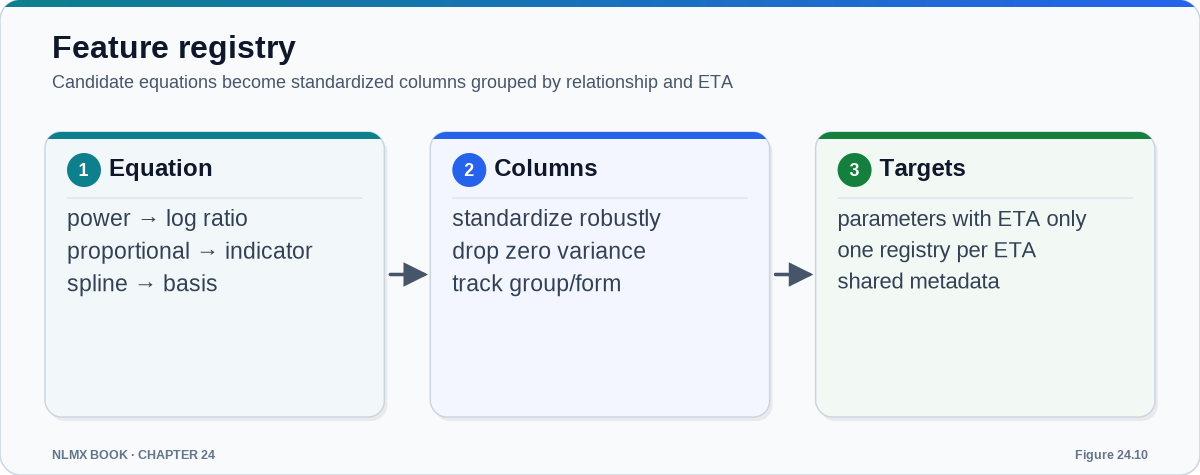
The posterior engine can test only parameters with an ETA because the learner response is subject random effects. A parameter without an ETA can be screened by the frozen engine but has no posterior response dimension. Linear and exponential forms can produce the same ETA-regression column and redundant forms are removed rather than counted twice.
Continuous features are standardized, zero-variance columns screened, and the total limited by --max-features. Verify that the feature equation corresponds to the intended population-model effect; regression-scale equivalence does not always imply identical extrapolation after model insertion.
Common mistakes
- Requesting posterior selection on a parameter without ETA.
- Counting duplicate linear/exponential columns as independent forms.
- Losing the mapping from standardized column to scientific equation.
- Ignoring sparse categorical indicators.
- Expanding features without a hypothesis plan.
Checklist
- Review every feature group and target ETA.
- Confirm equation/reference and column dimension.
- Inspect dropped/duplicate/zero-variance features.
- Preserve standardized-to-raw mappings.
- Keep feature count below a justified cap.
Further reading
Continue with standardization and redundancy and Chapter 22's equation catalogue.