39.23 Frequently asked troubleshooting questions
What you will learn
- Answer common questions with evidence
- Avoid unsafe shortcuts
- Know when to escalate
Prerequisites: Chapter 36 exit-code reference, Chapter 38 output completion, and the Chapter 39 overview.
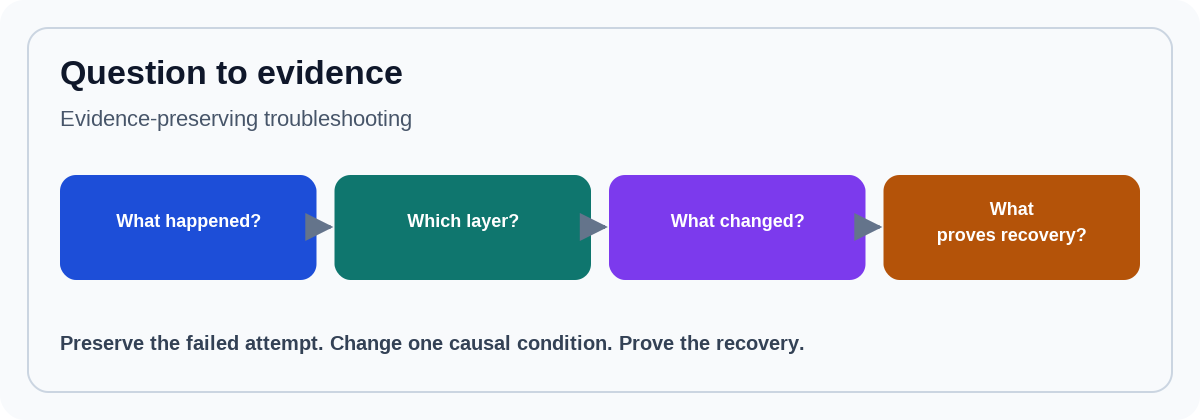
This page describes nlmx 4.16.2. Troubleshooting must preserve the failed attempt: keep its exact command, working directory, log, resolved settings, input/model identities, partial outputs, and process exit code. Correct one causal condition at a time and compare the new evidence with the failed run. Never convert a nonzero exit into success in a wrapper, and never interpret exit 0 as scientific acceptance without the command-native verdict.
“The folder contains results. Did the run finish?”
Not necessarily. Check the process exit, final log, command-native status, expected inventory, and checksums. Files are written during stages.
“Can I use --overwrite to fix ‘already exists’?”
Only after identifying and preserving the existing evidence. A fresh attempt folder is safer because stale optional files can survive.
“Exit 0 means PASS, right?”
It means the process completed. Inspect QC verdict, convergence/covariance, failed children/replicates, warnings, exclusions, and scientific acceptance.
“Can I ignore a warning if estimates look reasonable?”
No. Classify and disposition it. Artifact mismatch, population loss, covariance failure, fallback, or omitted figures can be material even when estimates look plausible.
“Should I increase iterations/tolerance?”
Only after diagnosing the earliest numerical cause. Changing numerics can alter the solution and must be justified and compared.
“Can I delete one bad subject?”
Not as troubleshooting. Verify source data, model domain, and prespecified exclusion policy. Quantify impact and run sensitivity analysis when justified.
“Why is there no log?”
The failure may precede output preparation—especially CLI parsing. Capture stderr and the shell exit code.
“Why did resume refuse after a tiny settings edit?”
The checkpoint represents exact computational identity. Begin a new run when settings/input/version/RNG identity changes.
“Can I copy .cov from another run?”
No. That creates an inconsistent family unless it is demonstrably the same run artifact. Use one coherent, hashed family.
“When should I report a bug?”
Always for exit 12; also for reproducible behavior that contradicts documented/versioned behavior after a minimal controlled check. Send a sanitized reproducer and evidence bundle.
Page checklist
- Did you retain the exact exit code, stage, message, hint, log, and partial output?
- Did you identify one causal layer before changing anything?
- Is the recovery a new, traceable attempt with the same intended estimand?
- Did you check command-native and scientific acceptance after process completion?
Navigation
See the previous page, next page, and complete error reference.