24.5 PHI means and ETC covariance
A PHI file can provide subject ETA estimates and ETC columns representing posterior covariance. nlmx reconciles subject identifiers, ETA dimensions, and covariance layout. The Chapter 24 base supplied 60 subjects with ETA1/ETA2 means and complete ETC covariance, so all subjects used PHI mean plus PHI ETC.
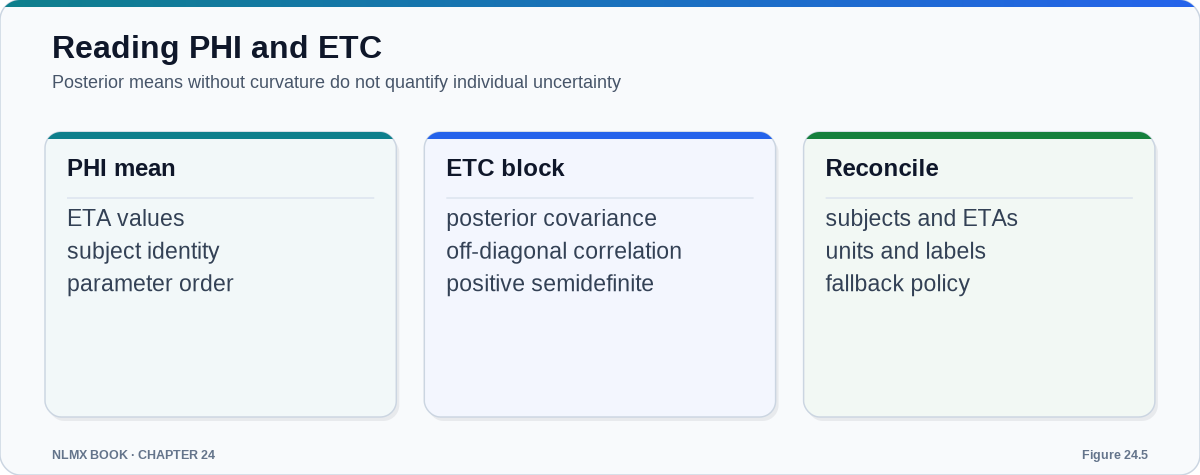
Validate that PHI belongs to the same fit, data, and parameter ordering as EXT/COV/control stream. Check duplicate or absent IDs, nonfinite values, symmetry, diagonal positivity, and correlation bounds. ETC absence does not turn a mode into a distribution; the default policy reconstructs curvature when possible.
PHI estimates may be modes rather than posterior means depending on producer conventions. Document semantics and verify the posterior moment identity. A numerically complete file can still be incompatible with nlmx's parameterization or approximation.
Subject-level posterior outputs may be sensitive. nlmx hashes IDs unless --keep-subject-ids is explicitly used.
Common mistakes
- Using PHI from another model version.
- Assuming ETA columns are in the expected order.
- Treating missing ETC as zero variance.
- Ignoring off-diagonal ETC covariance.
- Publishing identifiable posterior summaries unnecessarily.
Checklist
- Verify artifact identity and subject coverage.
- Reconcile ETA labels and ETC layout.
- Review covariance validity and repairs.
- Document whether estimates are means or modes.
- Preserve privacy defaults.
Further reading
Continue to reconstruction, moment identity, and Chapter 20's PHI output page.