Mathematical notation, parameter scales, and version stamps
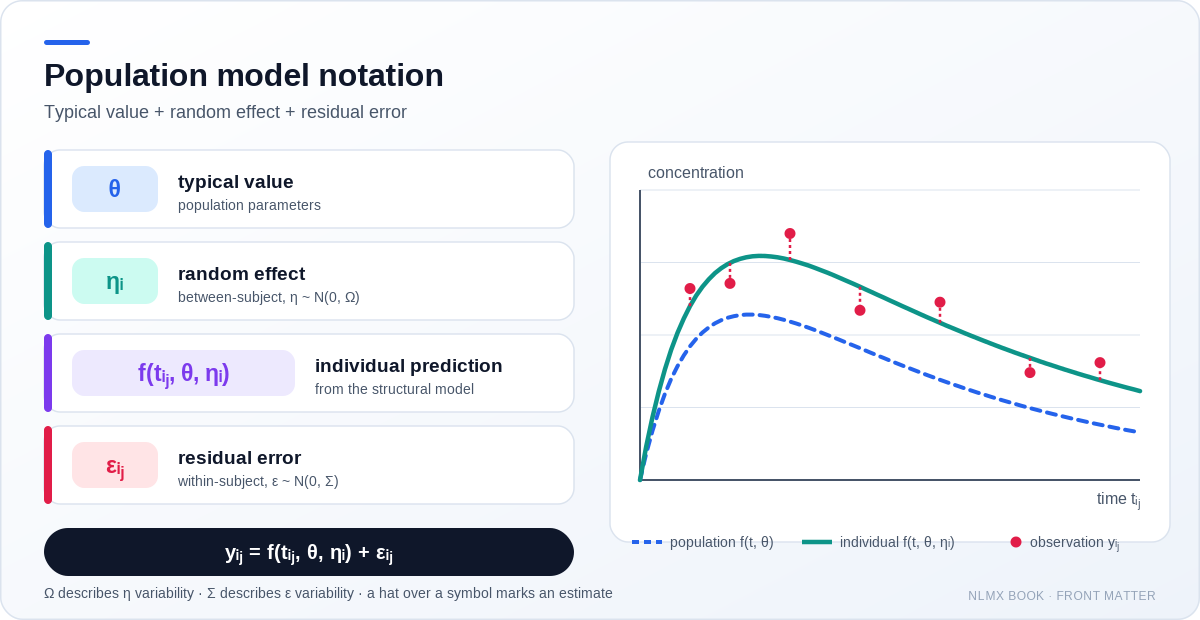
Pharmacometrics uses compact symbols that can hide important distinctions: population versus individual quantities, variance versus standard deviation, natural versus transformed scales, and truth versus estimate. This page supplies the default notation for the book. A method page may define additional symbols or a different local convention; that local definition takes precedence and should be stated explicitly.
Indices and basic quantities
| Symbol | Meaning |
|---|---|
| \(i = 1,\ldots,N\) | individual or subject index |
| \(j = 1,\ldots,n_i\) | record or observation index within subject \(i\) |
| \(k\) | parameter, covariate, bin, occasion, or simulation index as locally defined |
| \(t_{ij}\) | time of record/observation \(j\) for subject \(i\) |
| \(y_{ij}\) | observed dependent variable, commonly concentration or response |
| \(f_{ij}\) | model prediction before residual error; page states whether population or individual |
| \(\hat y_{ij}\) | estimated/predicted value; hat means computed from estimates |
| \(x_i\), \(x_{ij}\) | subject-level or record-level covariate |
Uppercase data-column names such as DV, PRED, IPRED, TIME, WT, or EVID denote actual columns. Mathematical symbols denote abstract quantities. A column called PRED must still be checked for its exact definition in the producing command.
Fixed and random effects
| Symbol | Meaning | Frequent implementation label |
|---|---|---|
| \(\boldsymbol\theta\) | population fixed-effect parameter vector | THETA(1), THETA1, parameter labels |
| \(\theta_k\) | fixed effect \(k\) | typical value, coefficient, or transformed parameter |
| \(\boldsymbol\eta_i\) | subject-level random-effect vector | ETA(1), EBE columns |
| \(\boldsymbol\Omega\) | covariance matrix of \(\boldsymbol\eta_i\) | $OMEGA, omega/covariance outputs |
| \(\boldsymbol\epsilon_{ij}\) | residual random variable(s) | EPS(1) or simulated residual stream |
| \(\boldsymbol\Sigma\) | residual covariance matrix | $SIGMA, sigma outputs |
| \(\kappa_{io}\) | occasion-level random effect when used | IOV effect, local notation may differ |
The default population assumption is often \(\boldsymbol\eta_i \sim N(\mathbf 0,\boldsymbol\Omega)\). Residual assumptions depend on the error model. Never report an \(\Omega\) diagonal value as a coefficient of variation without applying the model's transformation and definition.
Typical and individual parameters
A common log-normal relationship is
where \(P_{\mathrm{TV},i}\) is the typical parameter for subject \(i\), including covariates, and \(P_i\) is the individual's parameter. An additive relationship \(P_i=P_{\mathrm{TV},i}+\eta_{Pi}\) has different units, bounds, and interpretation. Pages must not use “ETA on clearance” as though the transformation were self-evident.
For a normalized power covariate model,
\(\theta_{CL}\) is typical clearance at reference weight \(WT_{ref}\), and \(\theta_{WT}\) is an exponent. For a categorical proportional effect, the coefficient may represent a ratio, log-ratio, fractional change, or indicator coefficient depending on the equation. The covariate chapters state the form before interpreting the number.
Estimates, truth, uncertainty, and draws
| Notation | Meaning |
|---|---|
| \(\hat\theta\) | point estimate of \(\theta\) |
| \(\theta^{(b)}\) | value in bootstrap, simulation, posterior, or parameter draw \(b\) |
| \(SE(\hat\theta)\) | standard error on the stated parameter scale |
| \(CI_{1-\alpha}\) | confidence interval at level \(1-\alpha\), with method stated |
| \(RSE\) | relative standard error, usually (100\times SE/ |
| \(\theta_{true}\) | known simulation truth, not an estimate |
A standard error for log(CL) is not numerically the same as a standard error for CL. Back-transformed intervals are generally asymmetric. Before comparing uncertainty across software, align parameter order, scale, covariance definition, and transformation method.
Likelihood and objective notation
The book commonly uses \(L(\theta)\) for likelihood, \(\ell(\theta)=\log L(\theta)\) for log likelihood, and \(OFV=-2\ell\) for an objective on the NONMEM-style scale when that definition applies. Some implementations retain or omit normalizing constants. A constant OFV difference can coexist with identical parameter estimates and likelihood ratios, but it must be explained before thresholds are compared.
\(\Delta OFV\) means a stated difference between nested or compared models. The sign convention, degrees of freedom, and direction must be explicit. A threshold such as 3.84 is not universal when boundary parameters, multiplicity, non-nested models, stochastic objectives, or different degrees of freedom apply.
Matrices, vectors, and numerical operators
Bold lowercase symbols are vectors; bold uppercase symbols are matrices. Superscript \(T\) denotes transpose, \(A^{-1}\) inverse when it exists, \(A^{+}\) a pseudoinverse, \(|A|\) determinant when context is a matrix, and \(\operatorname{diag}(A)\) its diagonal. \(I\) denotes an identity matrix, with dimension inferred or stated.
Information, Hessian, covariance, correlation, and sandwich matrices are not interchangeable. The method page states whether a matrix is observed or expected, on which parameter scale it is evaluated, whether nuisance blocks are included, and which repair or pseudoinverse rule is used.
Units and transformations
Symbols do not imply units. A table or example should declare concentration, dose, time, clearance, volume, and exposure units. Ratios may be dimensionless, but only when numerator and denominator units match. log means natural logarithm unless a page states otherwise; log10 explicitly denotes base 10. exp is the natural exponential.
Missing, BLQ, zero, and censored values are states with analysis-specific rules, not merely symbols. A dot . may be a NONMEM missing token, while NA or blank values may be parsed differently by context. Consult Chapters 4 and 6 and the command page.
Version stamps
The book uses version phrases carefully:
- Scoped to nlmx X.Y.Z — the page was checked against that release.
- Since X.Y.Z — the feature first appears in that release according to the changelog; later behavior still needs verification.
- Changed in X.Y.Z — the release altered behavior or evidence described by the statement.
- Deprecated — still available for a transition period; use the replacement and check removal plans.
- Planned — not implemented or not yet written; never use as evidence of availability.
Read the changelog from the installed version backward to the last qualified version. Review major, minor, and patch entries, including documentation-only and validation-package changes. Regenerate help, templates, and schemas after upgrading, and rerun the intended-use regression suite.
Navigation
See typographic conventions, continue to numbering and companion files, or use Chapter 18 for estimation notation in depth.