37.1 How to read this settings reference
Chapter 37 is a lookup reference for nlmx 4.16.2 settings files. A settings file is plain-text TOML, but its extension identifies the command that owns it. The extension is part of the interface: study.nca and study.vpc may both contain TOML, yet the commands reject the wrong suffix because otherwise a valid-looking file could be interpreted by the wrong analysis.
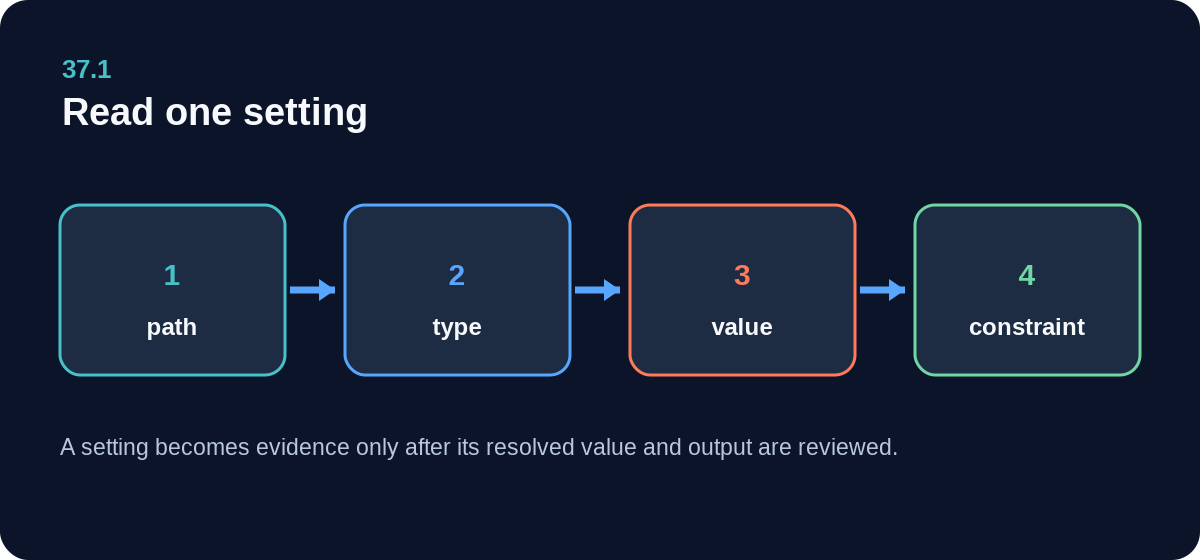
The six questions to ask for every setting
- Where is it? Use the full dotted path, such as
analysis.method, not the bare keymethod. - What type is it? TOML distinguishes strings, numbers, Booleans, arrays, tables and arrays of tables.
"false"is a string;falseis a Boolean. - Is the template value active? An uncommented assignment participates in the generated example. A commented assignment is available but unset. Neither should be called a built-in default unless the template or command explicitly says so.
- What values are accepted? Enumerations, numeric ranges and cross-field requirements are recorded in annotations and command-specific chapters. Unknown keys are rejected, so spelling matters.
- Where does a relative path start? Normally it starts at the folder containing the settings file. Confirm the command-specific rule and the resolved path printed at startup.
- What wins? A supplied CLI option normally overrides the corresponding settings value for that invocation. The unchanged file alone is therefore not the complete recipe.
TOML essentials for a novice
[analysis]
method = "fim"          # string
replicates = 500        # integer
uncertainty = true      # Boolean
quantiles = [5, 50, 95] # array
Table headers establish context until the next header. Comments begin with #. Strings need quotes. A repeated structure uses an array of tables, for example [[plot]]; each new header begins another plot object. Do not copy a value out of its table and assume it means the same thing at the top level.
How the catalogues were made
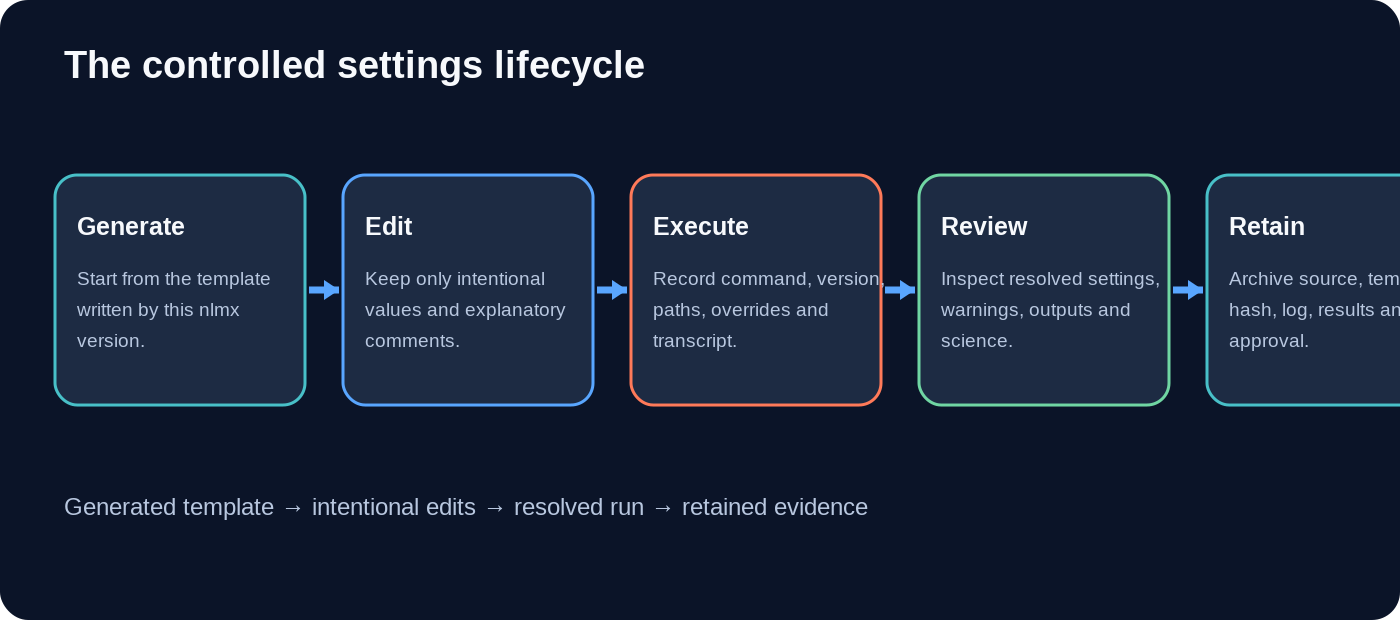
The 16 template snapshots linked in this chapter were written by the installed nlmx 4.16.2 executable. The key tables preserve active and commented assignments, syntactic type, sample value, nearby annotation and SHA-256 provenance. Some annotations describe a default or allowed set; other lines do not. Where the executable does not declare a default in the template, this chapter says so instead of guessing.
The catalogues are an interface inventory, not a substitute for the method chapters. A valid type and allowed token can still be scientifically inappropriate. Follow each format's orientation page before using its exhaustive key page.
Navigation
See the previous page, next page, and complete settings reference.