Runtime, memory, disk, and run planning
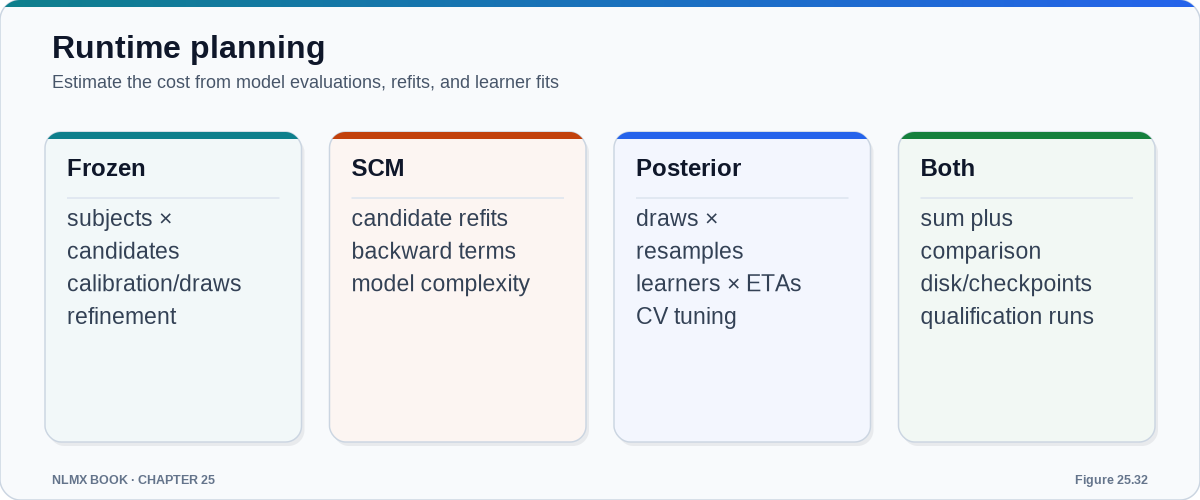
Frozen cost grows with subject evaluations, candidates, uncertainty draws, calibration replicates, matrices, and targeted refits. SCM cost grows with refitted candidates per forward step, active terms per backward step, and model estimation difficulty. Posterior cost grows with base draws × resamples × posterior draws × learners × target ETAs, plus cross-validation/tuning.
both approximately adds frozen and posterior costs and duplicates reports/drafts. Optional subject posteriors, posterior draws, replicate selections, subject scores, and matrices can dominate disk. Estimate counts from inspection/configuration, run a small labeled pilot, and reserve checkpoint-safe storage.
Do not lower replicate counts or candidate coverage after seeing results merely to meet runtime. Define a screening tier and a confirmatory tier in advance. Report hardware, threads, elapsed time, peak memory if measured, output size, failures, and checkpoint frequency with performance claims.
Common mistakes
- Changing the scientific question after seeing the result while presenting it as the original run.
- Reading one engine's summary without checking its prerequisites, failures, normalized settings, and fitted endpoint.
- Treating a generated draft, comparison label, or completed checkpoint as a substitute for model diagnostics and reference-software confirmation.
Page checklist
- The exact command, version, inputs, resolved settings, and output directory are identifiable.
- Engine-specific evidence is interpreted on its own scale before cross-method comparison.
- Recovery state, final refit, diagnostics, and remaining confirmation work are explicit.