19.12 MU-link detection and closed-form updates
A THETA/ETA pair is MU-linked when the model depends on them only through \(\varphi=g(\theta)+\eta\), with log or identity link. nlmx tests behavior numerically: shift THETA and ETA oppositely and require predictions and residual variance to remain unchanged within relative tolerance (10^{-8}) on the first three subjects. THETA must affect predictions alone.
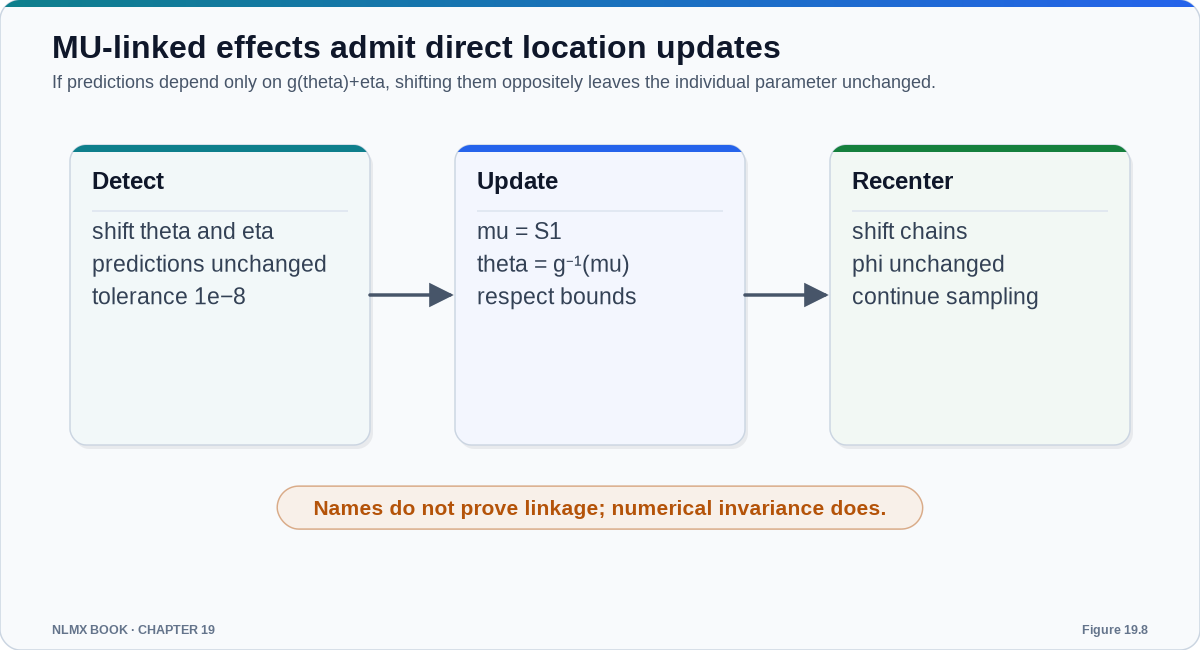
For a detected link, \(\mu=S_1\) and \(\theta=g^{-1}(\mu)\), respecting bounds. Chains shift by old minus new MU so individual \(\varphi\) remains unchanged. This separates population location from subject deviations efficiently.
CL=THETA(1)*EXP(ETA(1)) can qualify without a MU_1 variable. A THETA used elsewhere may fail exact linkage. Names are not evidence.
Practical interpretation
Construct positive and negative unit tests. In the positive case, multiply THETA by \(e^{0.2}\) and subtract 0.2 from ETA; every prediction and residual variance must match. In the negative case, reuse THETA in an unpaired parameter such as KA; predictions must change. Test covariate branches and several subjects so data-driven code cannot create a false link.
After an update, verify chain recentering leaves each individual phi and current likelihood unchanged. This distinguishes a coordinate change from a model change.
Repeat detection after model-code changes. A new use of the linked THETA in another equation can invalidate the closed-form assumption even though existing MU assignments remain syntactically unchanged.
Common mistakes
Do not force a closed-form update from syntax alone, ignore residual variance in invariance tests, or shift THETA without recentering chains.
Checklist
- Test prediction and variance invariance.
- Confirm THETA has independent influence.
- Identify log versus identity link.
- Respect bounds.
- Shift chains to preserve phi.
Further reading
Review Chapter 18 MU parameterization, then continue to OMEGA.