35.10 Using help, manual search, templates, and file reading
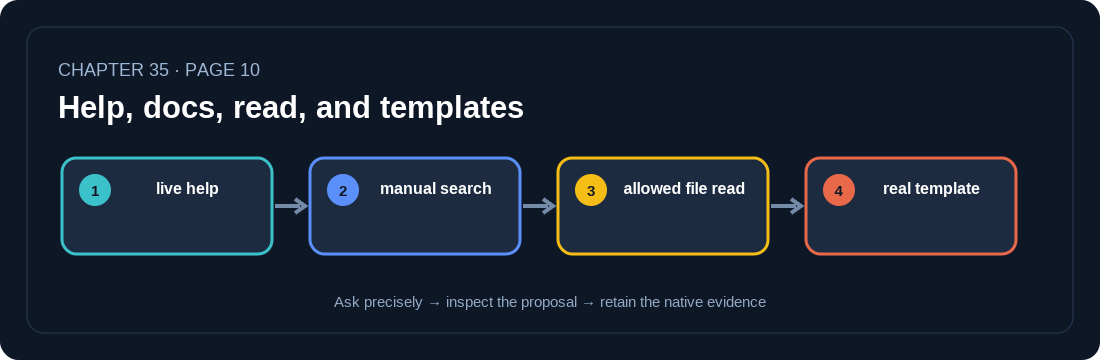
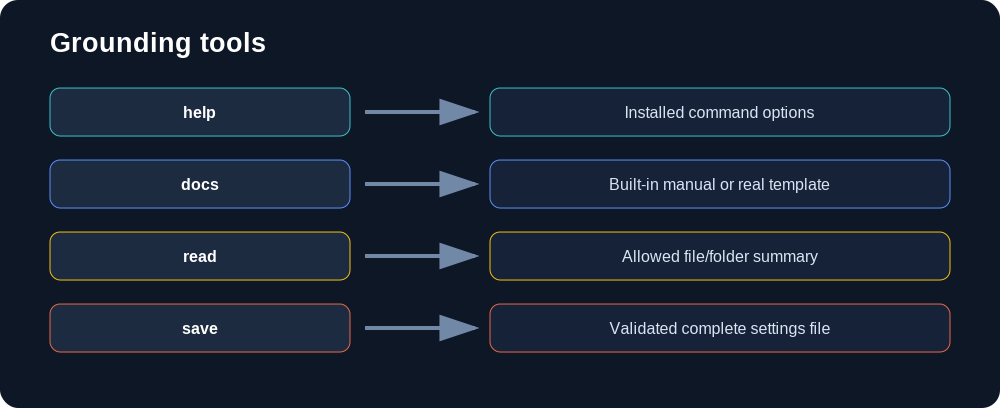
Maxson can request help for installed CLI options, docs for the compiled manual, docs: "template COMMAND" for a real settings template, and read for an allowed file/folder. These actions are logged and provide version-matched context.
How to use it
The manual is split by headings and searched with ranking that favors named commands. manual_chars controls automatic context; Maxson can request more. File reads support datasets, control streams, settings, logs and results; binary files and files over 50 MB are refused. Read policy still applies.
Practical interpretation
The executed help/docs/read session requested installed er help, the er template, and data/er/README.md; it ran zero analysis commands. Its JSONL log records help, template/docs and read events.
Executed/reference evidence: Help/docs/read event log.
A reliable information-first pattern
Ask Maxson to inspect installed help before it invents a complicated invocation: “Use help for er; do not run anything.” If the command needs a settings file, request the real template next. Then ask it to read only the relevant input header, settings, or prior result. This staged pattern reduces guessing and leaves an audit trail showing the evidence used for the proposal.
The four information actions have different authority. help reflects the installed parser. docs reflects the compiled manual and can return a template. read exposes permitted project material to the model. save writes a validated settings file inside the session. None of them proves the scientific suitability of a requested method. Manual excerpts can also be truncated by manual_chars; a model can ask for targeted material, but the operator should open the cited native documentation and generated settings when a decision matters.
A safe novice workflow
- Start with the narrowest backend, policy, files and command set that can answer the request.
- Name exact inputs and decisions; use guide or plan-only before granting execution.
- Inspect the normalized command and complete settings file, not only Maxson’s explanation.
- Read request end state, native command result, warnings, outputs and checksums.
- Preserve the session and record the qualified person’s interpretation and disposition.
Review and pitfalls
When advice matters, ask with the command name and verify the cited section. A retrieved excerpt can omit adjacent caveats. Request only files needed for the question and review what the event log says was read.
- A session exit code of zero does not prove that every proposal ran or succeeded.
- Model fluency, structured JSON, and policy approval do not establish scientific validity.
- Settings and commands are reproducibility inputs; they still require versioned software and frozen data.
What to retain
Retain .ask, backend/model identity, system prompt, request, raw/normalized replies, transcript, JSONL events, settings versions, commands, child logs/outputs, checksums, exceptions, and reviewer conclusions.
Navigation
See the previous page, next page, and complete ask command and settings index.