23.27 Multiplicity adjustment
The frozen engine computes univariate evidence for a family of candidates, then --adjust controls multiplicity. Available methods are none, bonferroni, holm, bh, by, and westfall-young. The default is Benjamini–Hochberg (bh).
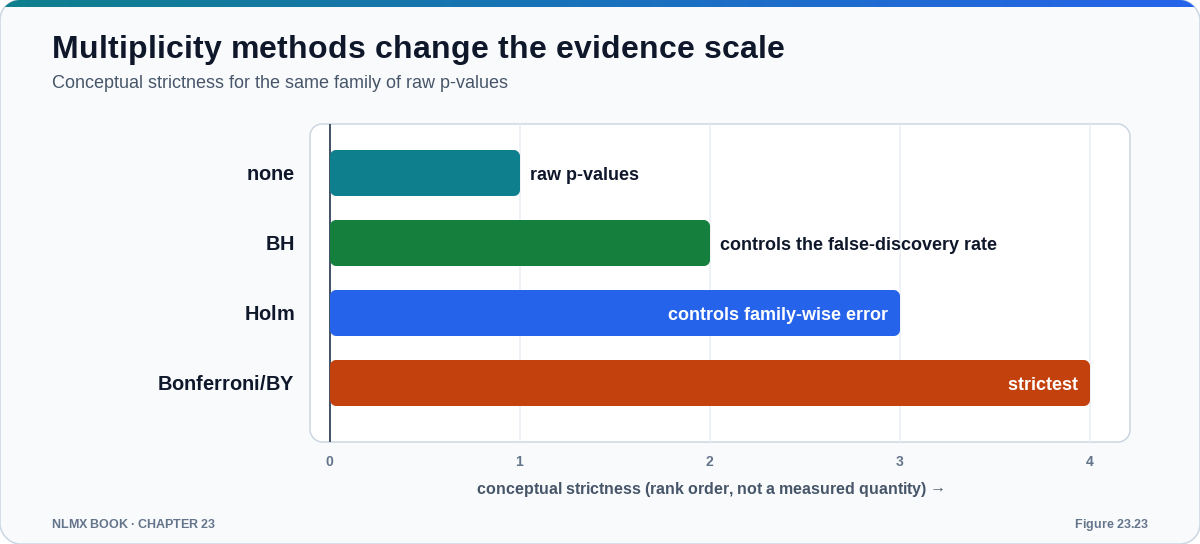
Bonferroni and Holm target family-wise error, with Holm generally less conservative. BH targets false-discovery-rate behavior under suitable dependence; BY is more conservative under arbitrary dependence. Westfall–Young uses an empirical joint null distribution from permutation and is described with calibration on the next pages. none can be appropriate for a very small prespecified family or descriptive work but must be explicit.
Define the family before analysis: all parameter–covariate pairs, all equation forms, or a hierarchy of scientific families. Expanding forms and categories increases opportunities even when output later displays one chosen form. Multiplicity adjustment does not correct model misspecification, selection-path dependence, or post hoc scope expansion.
Report raw and adjusted p-values. Conditional step p-values may use a different role from adjusted univariate screening evidence; label them separately instead of overwriting one with the other.
A pharmacometric family example
Suppose the plan tests WT, EGFR, AGE, and SEX on CL and V with one form per pair: eight relationship hypotheses form a natural family. If WT is tested with power, linear, and exponential forms, decide whether form selection occurs inside each relationship before the eight-pair family is adjusted, or whether all generated tests enter a larger family. Document the rule. Splitting CL and V into separate families may be defensible when they answer distinct prespecified questions, but doing so after seeing p-values is not. The normalized scope and equations table should permit another analyst to reconstruct the exact family.
Common mistakes
- Calling BH family-wise error control.
- Adjusting only retained candidates.
- Redefining the family after results are known.
- Assuming multiplicity adjustment replaces calibration.
- Mixing adjusted univariate and raw conditional p-values without labels.
Checklist
- Define the hypothesis family prospectively.
- Choose error-control objective and method.
- Preserve raw and adjusted evidence.
- Account for generated forms and blocks.
- Validate empirical error rates for the intended design.
Further reading
See permutation calibration, bootstrap and Westfall–Young, and Chapter 42 when drafted.