16.8 The autoinit NCA method
Autoinit NCA is a compact initialisation routine, not the full configurable nlmx nca command. It analyzes one useful interval per subject and returns starting evidence for CL, V, KA, ALAG, and sometimes two-compartment stripping parameters.
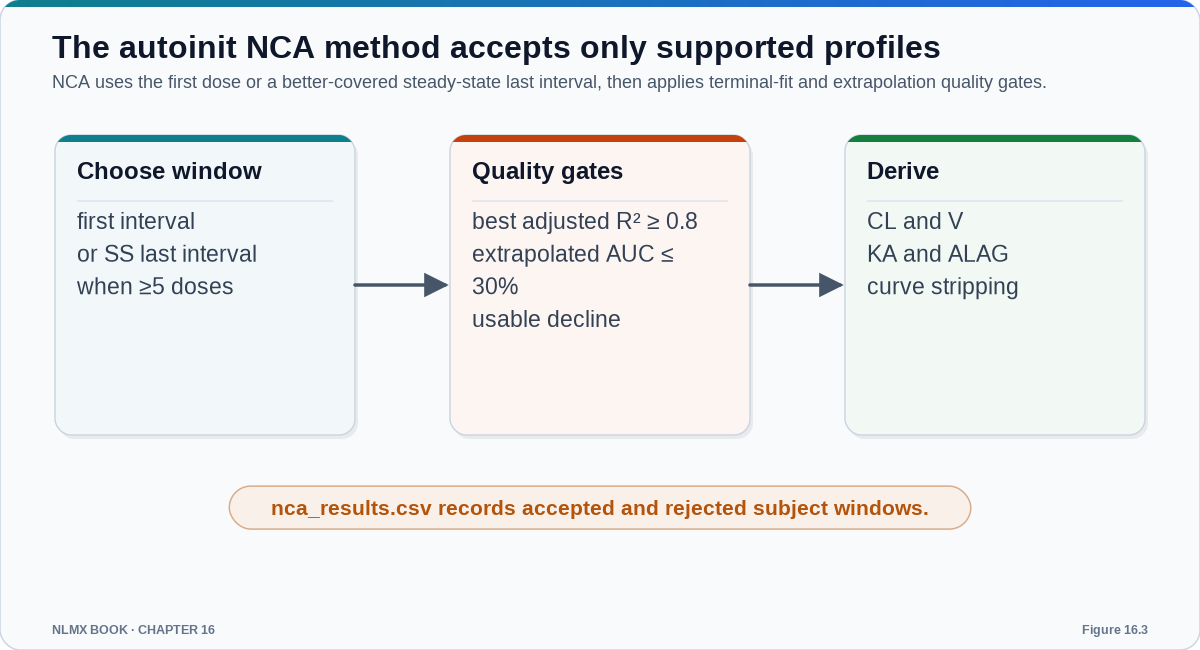
Window selection
The first dose interval is normally used. If a subject has at least five regular doses and the final steady-state interval has more measurable samples, that interval is preferred. nca_results.csv records WINDOW so the choice can be audited.
Lambda-z uses the last three or more declining observations and chooses the candidate with best adjusted R². --min-r2 defaults to 0.80—stricter than the full NCA command's 0.70 default. Linear-up/log-down AUC is extrapolated with Clast/lambda-z, and a subject is accepted only when extrapolation is no more than --max-extrap, default 30%.
At steady state, interval AUC is used. For extravascular profiles, CL and V are apparent. KA is solved from the Tmax relationship after lag; ALAG is the last nonmeasurable time before the first measurable concentration and is recommended only when at least a quarter of oral subjects show lag.
Curve stripping can produce V1, Q, and V2 for clearly biexponential profiles, but NLS provides the stronger structural check.
Evidence table
nca_results.csv includes route, window, dose, point counts, Cmax/Tmax, Tlast/Clast, AUClast/AUC, extrapolated percentage, lambda-z, adjusted R², half-life, CL/V/KA/ALAG, V1/Q/V2, USED, and NOTE. Rejected subjects remain visible.
Common mistakes
- Assuming Chapter 15 NCA settings apply here.
- Comparing first-dose and steady-state windows without reading WINDOW.
- Treating rejected NCA subjects as zero estimates.
- Interpreting oral CL/V without
/F.
Checklist
- Verify selected window per subject.
- Review R² and extrapolated percentage gates.
- Count USED versus rejected rows.
- Inspect lag prevalence and KA plausibility.
- Trace NCA contribution in SOURCE.
Further reading
See Chapter 14 NCA theory, full NCA command, NCA evidence output, and KA/lag interpretation.