36A.21 Traceability, provenance, and automated rebuilds
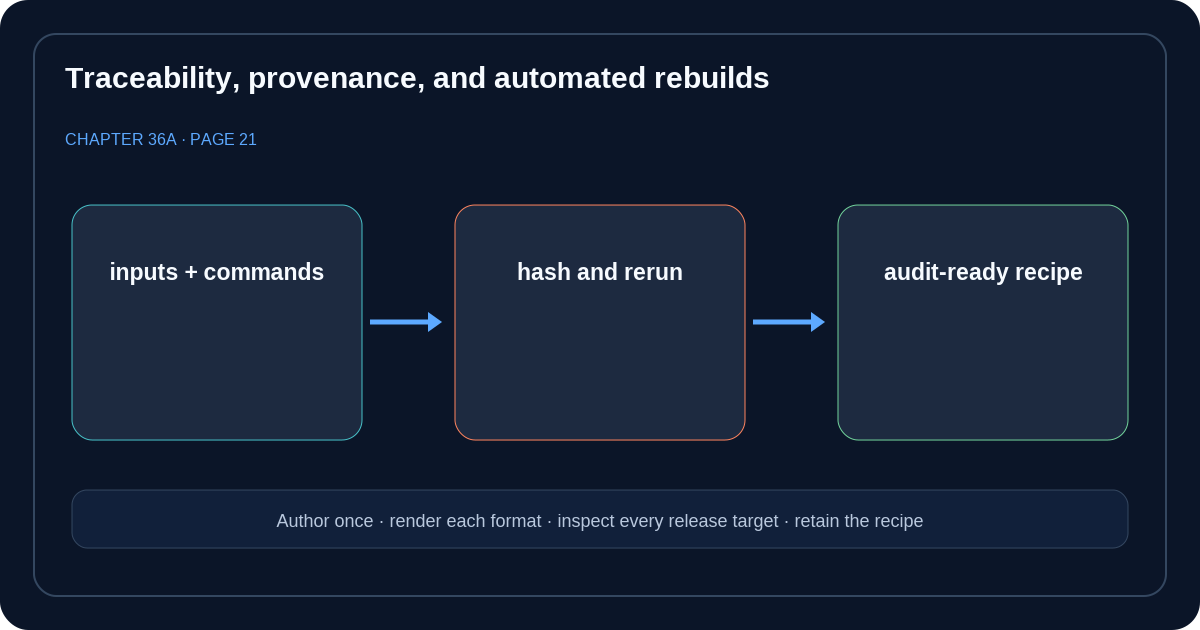
nlmx report publishes one Markdown source into retained Markdown, Word and PDF by default, with optional HTML. The command solves document generation; it does not validate the scientific analysis or approve its interpretation. Treat the source Markdown and .report file as the controlled recipe, and treat every released format as a separate review target.
The report recipe
Retain source Markdown, .report, custom CSS, local images, exact report command, log and output checksum. Retain every upstream command/settings file, input hash, output checksum, seed and version cited in the report. A report package without its upstream evidence is a presentation, not a reproducible analysis.
Use a stable project layout: immutable data, models, one output folder per analysis command, report source/settings, and generated deliverables. Paths in the source should resolve in that layout. A run_all script can rebuild analyses and report into clean folders; fail fast on nonzero exits and assert native verdicts/warnings before publishing.
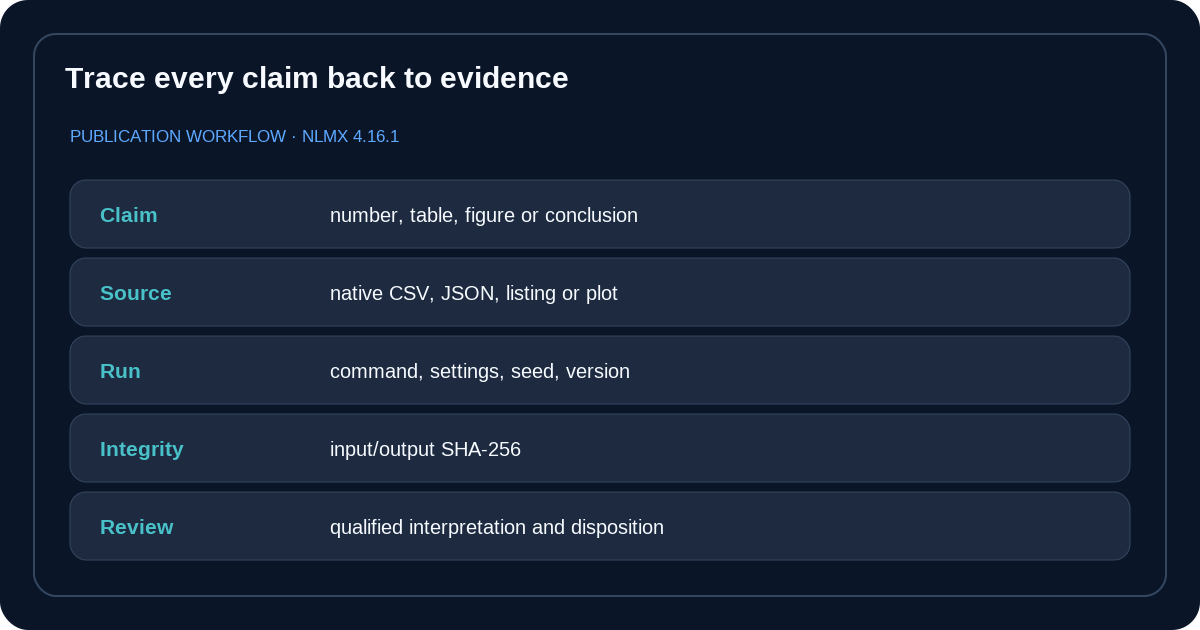
The provenance appendix should record software/version, dates, data/control-stream hashes, populations, commands in order, settings, seeds, output folders/checksum manifests, deviations, and approval. Fill it from logs/files, not memory. Under every table/figure provide a shorter source line.
report itself does not automatically write a default log or provenance. Supply --log-file, and write provenance into the content. The full executed evidence includes a requested log and generated output checksum. Top-level chapter checksums cover reference and QA evidence too.
Automated rebuild gate
A robust pipeline first verifies upstream checksum manifests and native verdicts, then builds Markdown/tables from controlled data, runs report, parses its log for warnings, checks expected formats, verifies report checksums, and queues visual review. Do not make --overwrite the default for initial execution; write a new attempt or archive the prior evidence. Record the exact executable path/version and environment needed for rendering. The final approval is a distinct record, not an inferred consequence of a zero exit code or matching hash.
Practical review questions
- Does the released content answer the stated question without exceeding the evidence?
- Can every number, table, figure and decision be traced to a retained native file and run?
- Were all generated targets—not merely the source—inspected after the latest change?
- Are warnings, failed runs, limitations and unverified steps visible rather than silently omitted?
- Could another qualified analyst rebuild the same document from the retained recipe?
Navigation
See the previous page, next page, and complete report reference.