Chapter 40 — Differences from NONMEM, PsN, PopED, and Monolix—and known limits
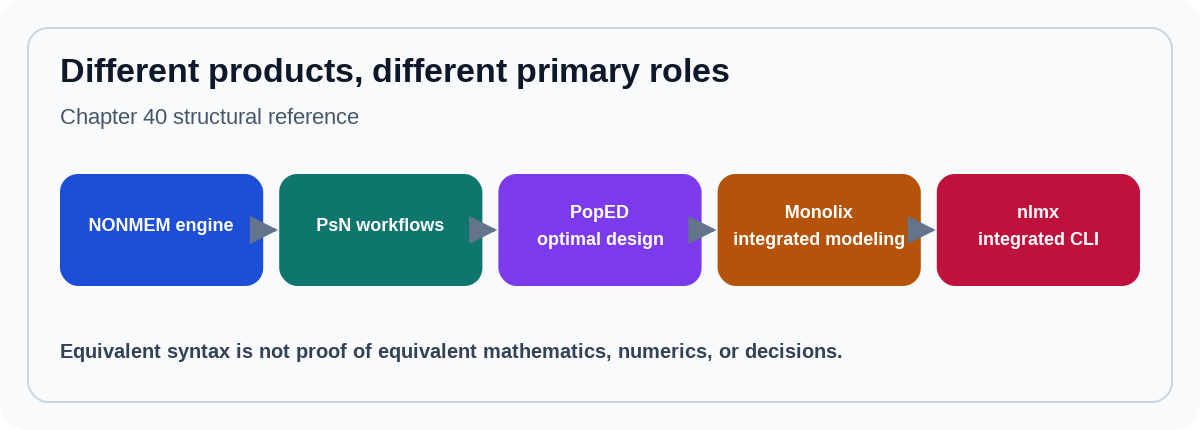
What you will learn
- Compare products by task and mathematical contract rather than brand-level checkmarks.
- Explain numerical differences in objectives, optimization, random streams, ODEs, and uncertainty.
- Use versioned matrices for models, estimation, covariates, diagnostics, simulation, power, and workflow scope.
- Migrate NONMEM, PsN, PopED, and Monolix work without silently changing the question.
- Benchmark speed only after accuracy and decision-equivalence gates pass.
- Document unsupported features and submit implementable feature requests.
Prerequisites: Chapter 5 NONMEM files, Chapter 9 numerics, Chapter 18 estimation theory, Chapter 30 trial-design theory, and Chapter 39 troubleshooting.
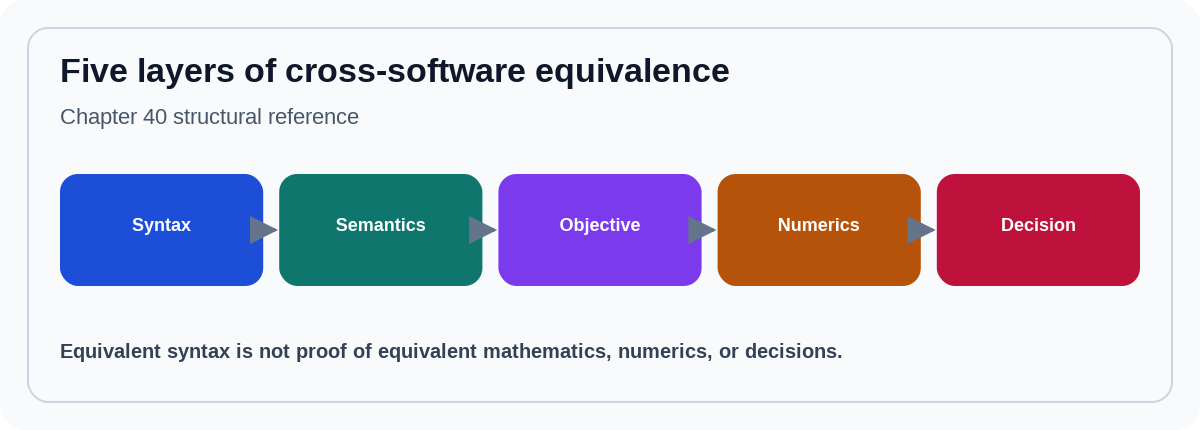
This chapter compares nlmx 4.16.2 with named external product roles using official documentation captured on 2026-11-10. It is not a leaderboard and makes no universal speed or accuracy claim. Its central distinction is that shared syntax or purpose does not establish shared semantics, objective, algorithm, or decision.
Start here
- Read how to compare and equivalence layers before any matrix.
- For numerical discrepancies, use why numbers differ, objectives, and uncertainty.
- For migration, use the dedicated NONMEM, PsN, PopED, or Monolix page.
- Use the complete comparison reference for the feature/limit matrices and official-source ledger.
The chapter contains 24 numbered pages, this overview, and the complete reference: 26 Markdown pages total. Continue with 40.1.