42.1 What validation does and does not cover
What you will learn
- Name the three layers that together make an analysis trustworthy, and the one that a test suite supports.
- Define intended use and why every validation claim is attached to one.
- Place the package in the regulatory vocabulary (21 CFR Part 11, software-validation guidance, GAMP 5, ALCOA+) without over-claiming.
- State plainly what the package is not.
Prerequisites: Chapter 36 command reference and Chapter 39 troubleshooting.
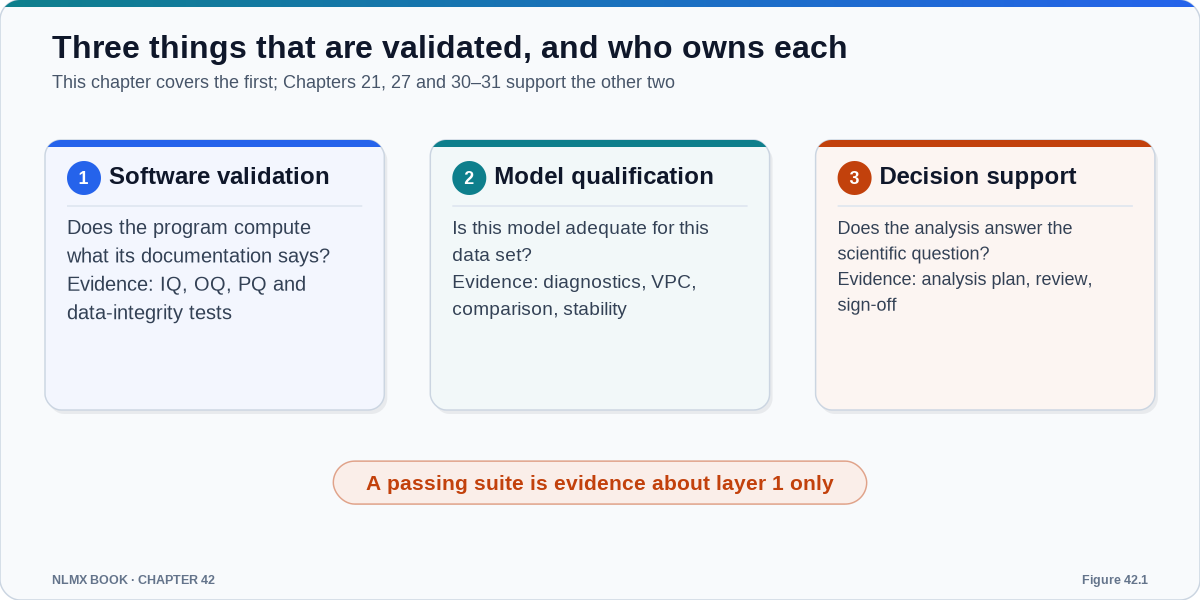
"Is nlmx validated?" is two questions wearing one coat. The first asks whether the program does what its documentation says. The second asks whether your analysis, run with the program, supports your decision. A test suite can answer the first and can only inform the second.
Three layers
Consider one ordinary result: a base model fitted to 150 subjects with a final objective function value (OFV) of −3017.9987.
- Software validation asks whether that OFV is the quantity the documentation says it is. If the exact marginal likelihood of a small data set is −144.2408, does the program's FOCE-I objective land within 0.5 of it? Does the same model written as an analytic solution, a linear differential-equation system and a general ODE give the same OFV? These are questions about the program and are answered with tests that do not depend on your data.
- Model qualification asks whether this model is adequate for this data set: goodness of fit, visual and numerical predictive checks, parameter precision, shrinkage, stability. They are the subject of Chapter 21 (diagnostics), Chapter 27 (predictive checks) and the stability engines of Chapters 24–25. No amount of software validation substitutes for them, and no model diagnostic substitutes for software validation.
- Decision support asks whether the analysis, as planned and reviewed, answers the scientific question: dose selection, sample size, covariate effects worth labelling. It lives in the analysis plan, the review and the sign-off.
A passing suite is evidence about layer 1. It is a precondition for layers 2 and 3, never a replacement.
Intended use comes first
Validation is always for something. The package's validation plan opens with a statement of intended use that the organisation completes: who uses the program, for which analyses, and whether results support non-clinical or clinical pharmacology, dose selection or a regulatory submission. The plan also lists what is out of scope unless added by change control:
- clinical-decision support for individual patients;
- use as an electronic-records or electronic-signature system;
- reliance on the content of the language-model assistant (Chapters 34–35) without human review.
The consequence is practical. A laboratory that uses only nca and eda for exploratory work can reasonably test those commands deeply and the rest lightly. A group that selects doses from sims and power raises the severity of those areas and tests them deeper. Chapter 42.4 shows how the risk scores carry that judgement.
Where the package sits in the regulatory vocabulary
The package states its design basis explicitly: 21 CFR Part 11 (electronic records), the FDA guidance on the general principles of software validation, GAMP 5 risk-based computerised-system validation, and ALCOA+ data-integrity expectations (attributable, legible, contemporaneous, original, accurate, plus complete, consistent, enduring, available). Three points keep the vocabulary honest.
- GAMP classification. The program is treated as configurable or custom analytical software (category 4/5). That classification drives the approach: requirements, risk-based testing of every function, and supplier documentation—but never reliance on the supplier's own testing alone.
- Black-box testing. The tests run the program and compare outputs. They give documented confidence for the intended use at a stated risk. They do not prove the absence of defects.
- Part 11 is an organisational property. The program has no user log-in, no operator identity and no electronic signatures. The package's clause-by-clause assessment says which controls are technical (transcripts, checksums, overwrite protection) and which are procedural and must be supplied by the operating environment and the quality system. Page 42.13 returns to this.
What the package is not
- It is not a certificate. Nothing in it states that the program or an organisation "is compliant". Validation is performed by named people, in their environment, under their quality system, who sign the records.
- It is not a test of your model. Fitness of a particular model is part of the analysis plan and population-PK practice, not software validation. The package does give you the evidence tools—checksums, input manifests, command lines, transcripts—to show what was run.
- It is not a test of the platform. The operating system, Python, file system, printer and network are outside it. IQ confirms only that the program can write, plot and use threads where it is installed.
- It is not a quality ranking of other software. Chapter 40's matrices describe roles, not leaderboards.
A worked illustration: one claim, three kinds of evidence
Suppose a report says: "WT on CL was retained; the final model reduced the OFV by more than 120 relative to the base model."
| Claim | Layer | Evidence you would cite |
|---|---|---|
| The OFV is computed as documented | 1 | OQ-FIT-002 (exact marginal likelihood), OQ-FIT-006 (three solvers agree), OQ-FIT-012 (closed-form standard errors) |
| The covariate screen finds true effects and rejects false ones | 1 | OQ-COV-001, PQ-002 (generated project with known effects CL |
| The model describes this study | 2 | VPC, GOF plots, shrinkage for this data (Chapters 21, 24–25 and 27) |
| A weight-based dose adjustment is warranted | 3 | Clinical relevance, forest plot, the analysis plan and review |
Only the first two rows come from the package. Writing the table in the validation summary prevents the most common over-claim: describing a passing suite as proof that a model is right.
Review checklist
- Is the intended use written down, with out-of-scope uses named?
- Does every claim in a report say which of the three layers supports it?
- Are procedural controls (access, identity, signatures) assigned to a named owner rather than assumed?
- Does anything in the summary read as "compliant" or "certified"? If so, rewrite it as a statement of evidence.
Navigation
See the chapter overview, the next page and the complete validation reference.