34.18 Compliance review and the final trust gate
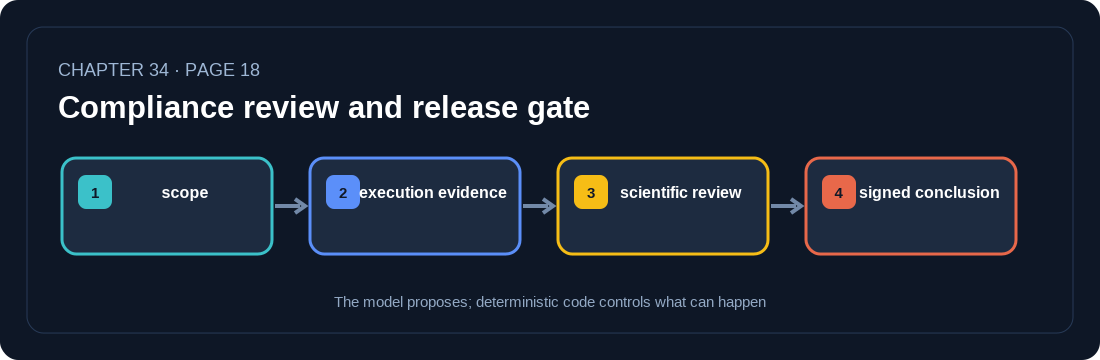
A review should reconstruct request, context, assistant/backend/version, policy, confirmation choice, proposals, refusals, settings lineage, executed arguments, child statuses, outputs, checksums, model-facing evidence, final wording, and human disposition. It should also identify any remote processing and sensitive content exposure.
How the mechanism works
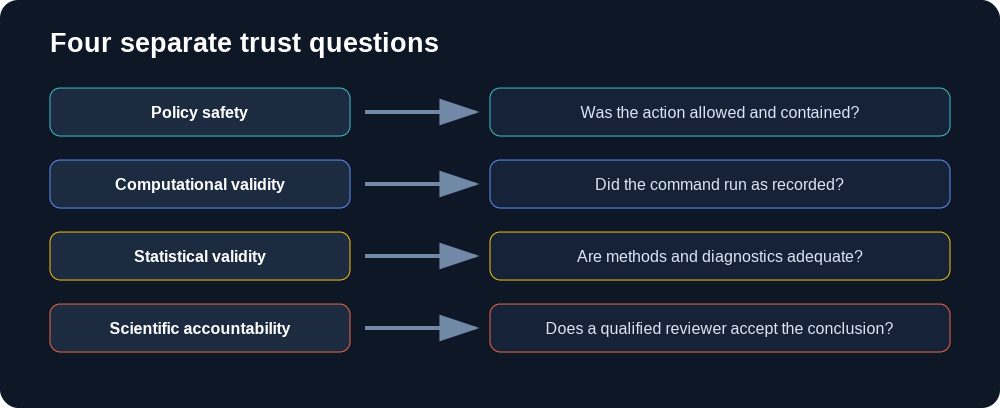
Use four separate release gates: policy containment, computational reproducibility, statistical adequacy, and scientific/causal acceptance. Document who approved each gate and which artifacts support it. A complete audit trail supports review; it does not itself satisfy organizational validation or electronic-record requirements.
Evidence from nlmx 4.16.1
Chapter 34 preserves three 4.16.1 mock sessions: approved real QC, checked plan-only, and enforced self-call refusal. Together they show the difference among proposed, planned, refused, and executed actions.
What the mechanism protects—and what it does not
The mechanism controls a defined part of the workflow. It does not make the model’s prose correct, select the right scientific question, validate external data, or transfer accountability away from the user. Treat policy safety, computational success, statistical adequacy, and scientific validity as separate conclusions.
Review practice
Release only conclusions traceable to native command evidence and reviewed assumptions. Preserve limitations, failed/refused steps, and disagreements. If the audit cannot distinguish what was proposed from what ran, the session is not decision-ready.
For a novice, read the human transcript first, then the JSONL event log, exact settings/commands, and native command outputs. “The session completed” describes the outer process only; individual proposals may have been planned, declined, refused, failed, corrected, or executed.
Evidence to retain
- nlmx version/build, backend identity,
.asksettings, policy, limits, and system prompt; - request, raw replies, help/manual/file context events, confirmations, refusals, and corrections;
- every settings version and exact executed command, with child exit status and full output;
- reviewer interpretation, unresolved warnings, scientific limitations, and final disposition.
Navigation
See the previous page, next page, and guardrail, policy, and audit index.