The backward-only full-model start
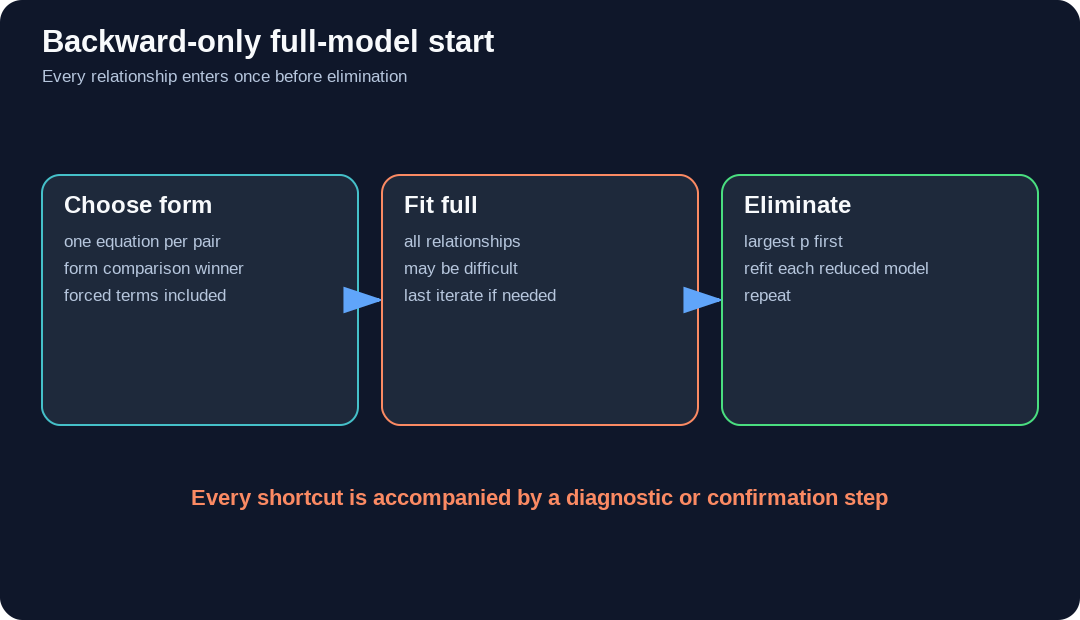
With --scm-direction backward, nlmx constructs a full starting model containing one equation per eligible relationship plus all forced terms. If multiple forms were requested, form comparison determines which equation represents each pair before that full fit. This full model is the reference from which one-term deletion models are compared.
The full start can be scientifically useful when the scope is small and estimable, because each relationship is assessed while every other scoped relationship is present. It is also the most fragile starting point when categories are sparse, covariates are correlated, or the number of coefficients is large. Review parameter boundaries, gradients, covariance behavior, and effective information before trusting deletion tests.
If the full optimization does not converge, nlmx can begin deletion from its last iterate so that recovery remains possible. That behavior must be reported prominently: the first comparisons no longer have the same evidentiary status as comparisons from a clean converged full model. Prefer simplifying or stabilizing a scientifically justified scope over treating last-iterate recovery as validation.
Common mistakes
- Treating a stepwise p-value as clinical importance or causal proof.
- Reading a candidate comparison without its active model, convergence state, degrees of freedom, and exact threshold.
- Reporting only the terminal relationship list while discarding failed models, path decisions, configuration, and provenance.
Page checklist
- The scientific question, model identities, and comparison direction are explicit.
- Numerical validity is reviewed before interpreting statistical evidence.
- The result is linked to the complete trace and final joint-model diagnostics.