30.30 Validation framework and final checklist
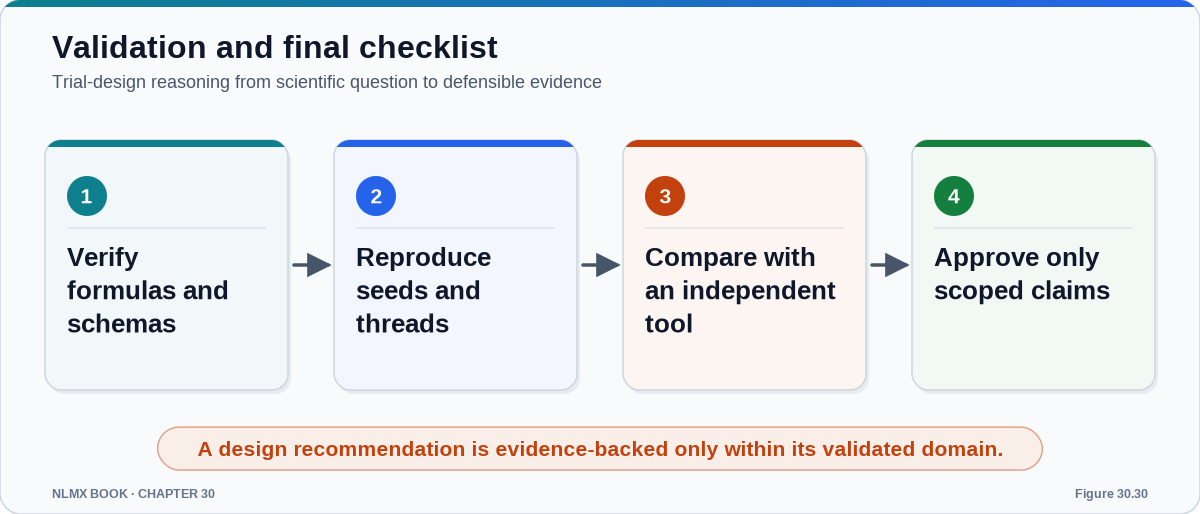
A power implementation should be verified at several layers: distribution mathematics, information derivatives, simulation determinism, model fitting, output aggregation, and cross-software agreement. Validation claims must name the tested versions, models, scenarios, tolerances, reference results, and known differences. Same-model recovery is useful evidence but not complete validation.
Concepts to keep separate
- Unit checks include chi-square critical values, noncentral power, lambda inversion, Wilson intervals, and interpolation.
- Numerical checks compare finite-difference steps, FIM ranks, analytic and numerical derivatives where possible, and repeated seeds/threads.
- Workflow checks reproduce replicate rows from saved truth and settings, including failures and resumed runs.
- Cross-software checks freeze inputs and definitions before comparing nlmx with NONMEM/PsN, PopED/PFIM, Monolix, or another independent implementation.
Terminology matters because a single scenario can contain several denominators and several sources of randomness. Truth is the parameter vector used to generate a replicate. Estimate is the value recovered from that replicate. Design is the planned arrangement of subjects, arms, doses, and observations. Method is the approximation or simulation–estimation procedure used to predict performance. A credible report labels all four.
Mathematical or operational walkthrough
The current Chapter 30 evidence verifies internal arithmetic and exposes a meaningful reduced/full distinction. It does not establish equivalence to any external package. That broader claim belongs to a prespecified validation matrix with acceptance tolerances.
For novices, read every expression from the inside out: identify the scientific effect, identify the null value, put both on the same parameter scale, identify the variance or information that belongs to the actual design, and only then calculate a test statistic or sample size. Units and parameterisation should cancel in a way that leaves a dimensionless statistic.
How this maps to nlmx
Before approving a design, confirm scientific scope, model adequacy, test calibration, precision of Monte Carlo estimates, convergence, parameter criteria, sensitivity scenarios, engine agreement, feasible allocation, complete provenance, and an explicit residual-risk statement.
Chapter 30 explains the statistical and implementation concepts. Chapter 31 gives the complete nlmx power command, every CLI and settings control, precedence, output schema, and production workflow. This separation is deliberate: choosing an option correctly requires understanding which estimand and assumption it changes.
Quality-control checklist
- Are formulas checked against independent reference values?
- Are seed and thread results reproducible?
- Are cross-software definitions genuinely matched?
- Is the claim no broader than the evidence?
The graph is explanatory; the CSV, JSON, resolved settings, model inputs, and replicate rows are the authoritative evidence. When a plotted point looks surprising, diagnose the underlying rows before changing the design.
Common mistakes
- Calling internal consistency external validation
- Changing tolerances after seeing discrepancies
- Treating agreement between two approximations as clinical truth
Also avoid copying a sample size from a nearby project. Power is conditional on the model, tested effect, covariate distribution, schedule, residual and random variability, attrition, test, estimator, and success criteria. Similar-looking studies can have very different information.
Evidence to retain
- scientific question, estimand, hypothesis, alpha, target, and criteria;
- model/data/design inputs, parameter source and uncertainty distribution;
- software version, method, approximation, seed, threads, command, and resolved settings;
- scenario grid, row-level results, failures, denominators, intervals, diagnostics, and checksums;
- scripts that calculate derived tables and figures, plus the interpretation and limitations.
Navigation
See the previous page, next page, and formula and decision index.