40.17 Migrating a PsN workflow to nlmx
What you will learn
- Separate PsN orchestration from NONMEM execution
- Translate workflow rules, not just command names
- Compare complete decision paths and failure handling
Prerequisites: Chapter 39 troubleshooting, Chapter 36 command reference, and Chapter 38 output reference.
This page is scoped to nlmx 4.16.2 and an external-documentation snapshot of 2026-11-10. Product names describe different system boundaries; a blank or “outside role” is not a quality ranking. Treat every migration as a new implementation until model semantics, analysis population, objective definition, numerical behavior, outputs, and decisions have been independently reconciled.
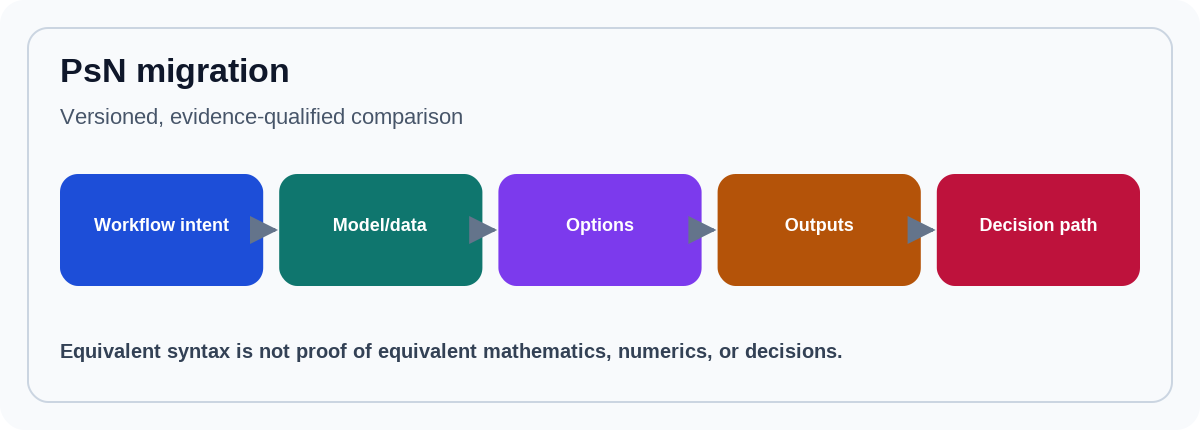
Inventory the PsN script/version, configured NONMEM version, model/data, configuration, common options, retries/threads, generated models/data, raw results, logs, and final report. Identify which layer owns each result. An SCM OFV comes from NONMEM; PsN owns candidate generation/search/reporting.
For SCM translate test relations, covariate types, valid states/equations, centering/reference, missing-data token, locked relationships, forward/backward direction and thresholds, criterion, failure/retry policy, and whether linearization is used. Configure nlmx SCM to refit all candidates per step when matching the classic exhaustive path; its default shortlist can be a speed strategy but is not path-equivalent.
For VPC/NPC align simulation model/estimates, samples, bins, prediction/reference/variability corrections, censoring, stratification, parameter uncertainty, and failed simulations. For SSE align simulated parameters, estimation model/method, retries, acceptance, and denominator. PsN offers workflows nlmx does not reproduce (e.g., some bootstrap/SIR/SCM variants); keep those in PsN or specify a new validated analogue.
Compare generated artifacts and decisions step by step, not only the final selected model or figure.
PsN SCM equality setting
When comparing classic exhaustive PsN SCM with nlmx SCM, configure nlmx to refit all eligible candidates per step rather than only a score-ranked shortlist. Match forward/backward thresholds and candidate equations, and decide how failed fits are treated. Once the exhaustive path is validated, the shortlist can be benchmarked as a distinct accelerated strategy. Report whether it preserved the decision path across the validation suite; do not label it identical by construction.
Primary source note: The official PsN repository describes PsN as programs/modules aiding NONMEM workflows; the SCM help defines its search controls.
Review checklist
- Are the exact product versions, task boundaries, inputs, methods, and settings named?
- Were semantics and frozen-parameter results aligned before optimized outputs?
- Is the comparison using a method-appropriate deterministic or stochastic tolerance?
- Are unsupported or analogous features described without implying equivalence?
- Can every claim be reproduced from retained primary evidence?
Navigation
See the previous page, next page, and complete comparison reference.