41.20 Case 5: stepwise covariate modelling on refits
What you will learn
- Follow a forward-backward search where every step is a model refit and every number is a measured OFV drop.
- Check the final model's OFV against the sum of the forward drops.
- See that five different search settings reach the same model, and what each costs.
- Resolve the uncertain candidates of the previous page.
Prerequisites: 41.19.
The question: when the candidates are actually fitted, which relationships survive?
The evidence: the Chapter 22 bundle scm (command: nlmx cov … --method scm --scm-direction both --scm-candidates-per-step 3 --seed 22048) and the Chapter 23A bundles both_full, both_accelerated, forward, backward and strict.
The procedure
Stepwise covariate modelling (SCM) alternates two stages.
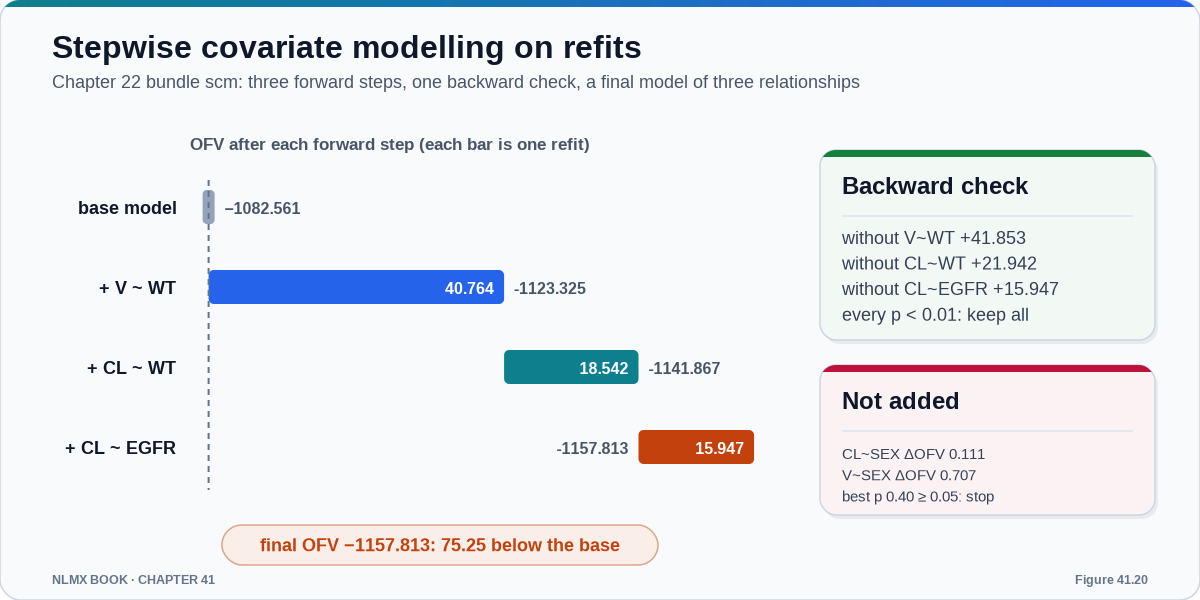
- Forward. Add each remaining candidate to the current model, refit, and keep the one with the largest OFV drop, if its likelihood-ratio p-value is below the forward level (0.05 here). Repeat until nothing qualifies.
- Backward. Remove each term in turn from the full forward model, refit, and drop any whose removal costs an OFV rise with p ≥ the retention level (0.01 here). Repeat until every term is justified.
With one degree of freedom per candidate, a drop of 3.84 corresponds to p = 0.05 and a drop of 6.63 to p = 0.01. The setting --scm-candidates-per-step 3 refits only the three candidates ranked best by the frozen screen at each forward step, instead of all of them: an accelerated search, compared with the exhaustive one below.
The forward stage, from the stored trace
| Step | Candidates refitted | Added | ΔOFV | p |
|---|---|---|---|---|
| 1 | V |
V ~ WT | 40.764 | 1.7e-10 |
| 2 | CL |
CL ~ WT | 18.542 | 1.7e-5 |
| 3 | CL |
CL ~ EGFR | 15.947 | 6.5e-5 |
| 4 | CL |
none: best p 0.40 ≥ 0.05 | — | — |
Two details are worth stopping at.
CL ~ WT is worth more after V ~ WT than before. Alone it dropped the OFV by 17.533; with V ~ WT in the model it drops it by 18.542. On the previous page the conditional score had fallen from 21.4 to 6.0 in the same situation. The refit says the opposite of what that one-step conditional score suggested: the evidence for CL ~ WT does not weaken in company; it strengthens a little. This is the case for refitting any candidate a screen calls uncertain.
The OFV bookkeeping closes. Starting from the base OFV of −1082.561:
−1082.561 − 40.764 = −1123.325 (the V ~ WT model) −1123.325 − 18.542 = −1141.867 (adds CL ~ WT) −1141.867 − 15.947 = −1157.814 (adds CL ~ EGFR)
and the final joint refit reports −1157.813, which differs from the running sum only in the last printed digit. The total drop is 75.25 for three extra parameters.
The backward stage
The full three-term model is refitted with each term removed in turn:
| Term removed | OFV rise | p | Verdict |
|---|---|---|---|
| V ~ WT | 41.853 | 9.8e-11 | keep |
| CL ~ WT | 21.942 | 2.8e-6 | keep |
| CL ~ EGFR | 15.947 | 6.5e-5 | keep |
Every p is far below 0.01, so the backward stage stops after one step.
The final model
CL = TVCL × (WT/72.2)^0.7268 × (EGFR/93.62)^0.5776
V  = TVV  × (WT/72.2)^1.010
Typical values are re-estimated jointly: the draft written by the engine carries the coefficients 0.72682, 0.57762 and 1.01002. The weight exponents have a physiological reading that a reader can check at a glance: clearance scales sub-linearly with weight (0.73), while volume scales almost linearly (1.01). Page 41.24 refits this model as a normal control stream and reads its uncertainty.
The SEX terms stay out: ΔOFV 0.111 for CL and 0.707 for V.
Five search settings, one model
The Chapter 23A bundles repeat the search with other settings.
| Bundle | Direction | Candidates refitted per forward step | α forward / retention | Refit lines in the trace | Final model |
|---|---|---|---|---|---|
both_full |
both | all | 0.05 / 0.01 | 17 | V |
both_accelerated |
both | 3 | 0.05 / 0.01 | 14 | the same |
forward |
forward only | all | 0.05 / 0.01 | 14 | the same |
backward |
backward only | — | 0.05 / 0.01 | 12 (+ the full-model fit) | the same |
strict |
both | all | 0.01 / 0.001 | 17 | the same |
All five end at OFV −1157.813 with coefficients [0.72682, 0.57762, 1.01002]; the backward run, whose coefficients are printed as 0.72681, 0.57761, 1.01002, is the same fit to five digits. The backward run starts from the full five-relationship model, whose OFV is −1158.649 (76.088 below the base), then removes CL ~ SEX (rise 0.128) and V ~ SEX (rise 0.707) one at a time; the two small drops add up to 0.835, which is the 1158.649 − 1157.813 = 0.836 difference up to rounding.
"Refit lines" counts the trace entries that report an OFV change; it is a proxy for the number of refits, not a timing. The accelerated search saves three refits here (14 against 17) and loses nothing. With a long candidate list and slow fits the saving grows, which is why the setting exists; the exhaustive search remains the reference.
The strict run is the reassuring one. Tightening the entry level from 0.05 to 0.01 and the retention level from 0.01 to 0.001 could, in principle, have dropped CL ~ EGFR, whose retention p is 6.5e-5. It does not, because the evidence is stronger than either pair of thresholds.
Reading the two pages together
| Frozen screen (41.19) | Refit SCM (this page) | |
|---|---|---|
| V ~ WT | retained | retained |
| CL ~ WT | uncertain | retained (ΔOFV 21.9 on removal) |
| CL ~ EGFR | uncertain | retained (ΔOFV 15.9 on removal) |
| SEX terms | rejected | rejected |
| Cost | 4 980 subject evaluations, no refits | 12 to 17 refits |
The refit resolves what the screen flagged. Nothing in the refit contradicts the screen's ordering of the evidence; it adds the measurement the screen only approximated.
The decision
| Question | Evidence | Decision | Reversible? |
|---|---|---|---|
| Which relationships enter the model? | forward and backward OFV drops | V ~ WT, CL ~ WT, CL ~ EGFR | yes |
| Do the search settings matter here? | five variants, same model | no | yes |
| Is it confirmed? | refit OFV −1157.813 | yes, by explicit fit | yes |
What this case does not show
SCM selects on the same data it then reports; the OFV drops of the retained terms are not corrected for the selection. The uncertainty of the coefficients, and how often a resampled data set would select the same terms, are the subject of pages 41.22 and 41.24. SCM also cannot say anything about relationships that were not offered.
Review checklist
- Do the forward ΔOFV values sum to the final OFV drop?
- Do you know the forward and retention levels used, and do they appear in the report?
- Did you refit every term a faster screen called uncertain?
- Have you tried at least one other search setting to see whether the model moves?
Navigation
See the previous page, the next page and the complete case-study reference.