36A.15 Choosing Markdown, Word, PDF, and HTML outputs
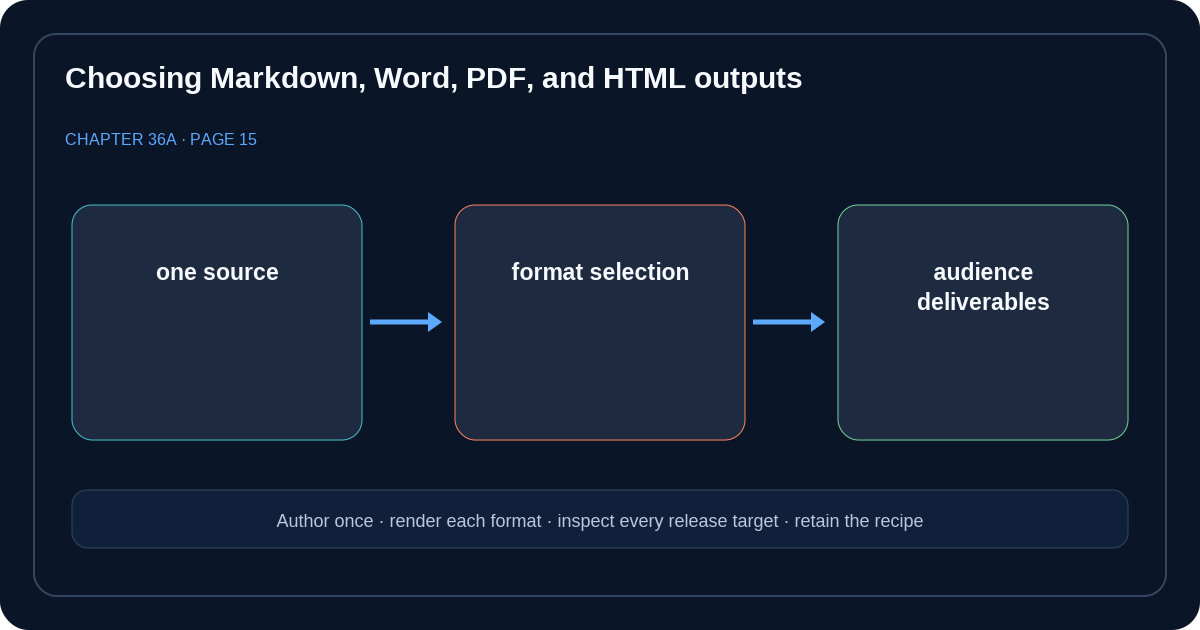
nlmx report publishes one Markdown source into retained Markdown, Word and PDF by default, with optional HTML. The command solves document generation; it does not validate the scientific analysis or approve its interpretation. Treat the source Markdown and .report file as the controlled recipe, and treat every released format as a separate review target.
The four outputs have different jobs
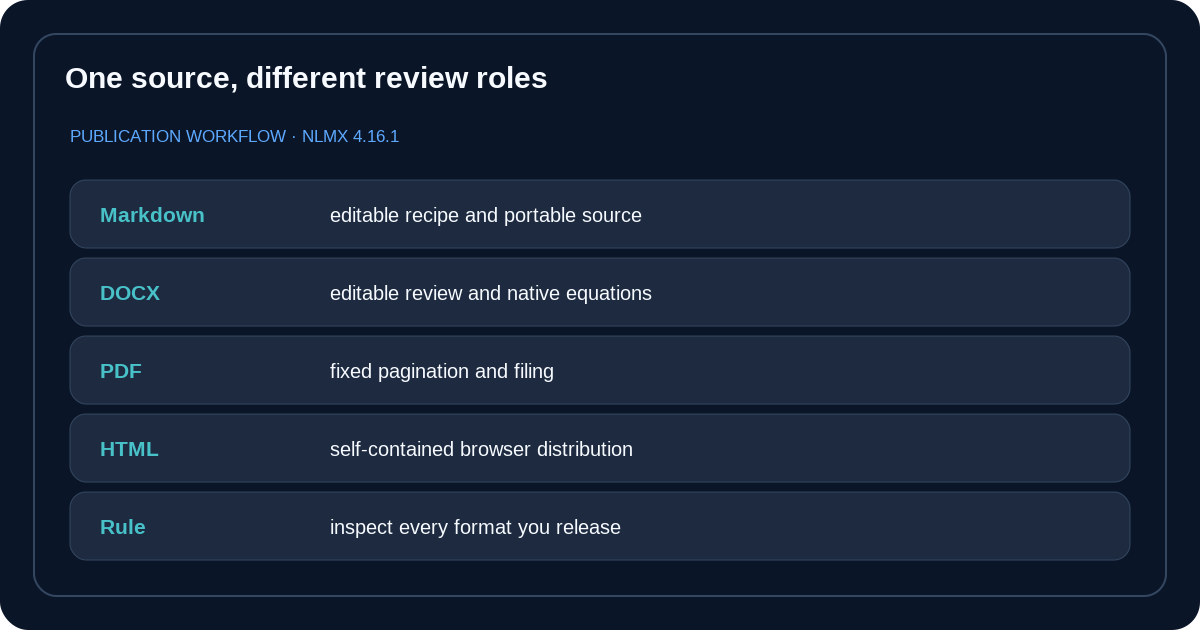
Markdown is always written and cannot be disabled. It is the editable, diffable source recipe and retains math/source syntax. DOCX is written by default for editable review, tracked organizational workflows and native Word equations. PDF is written by default for fixed pagination, filing and consistent visual review. HTML is off by default and is useful for self-contained browser distribution.
Choose formats by recipient and governance, not habit. A sponsor may need both editable DOCX and filed PDF; a reproducible analysis package should retain Markdown/settings; an internal portal may use HTML. Switching off a format reduces QA burden but also removes that deliverable.
All formats come from one source but are not pixel-identical. Word uses styles/fields and viewer-dependent layout. PDF is fixed. HTML reflows and obeys CSS. Footnotes, TOC page numbers, equations and raw HTML differ by target. Therefore “generated from one source” means content consistency, not that reviewing one target proves the others.
The full executed fixture wrote four outputs. The inline example wrote Markdown+HTML; the stdin example wrote Markdown only. Each output set includes its own checksum manifest.
Format-selection example
For an internal analysis review, retain Markdown and deliver DOCX for comments plus PDF for stable discussion. For an archival package, retain all source/evidence and release the approved PDF; do not assume ordinary PDF is PDF/A. For a web knowledge base, add HTML but still keep Markdown and inspect responsive/print behavior. Disable an output only with an explicit rationale. Fewer outputs reduce review burden, whereas unnecessary formats create unmanaged copies. Put all formats from one build under one base name and checksum them together.
Practical review questions
- Does the released content answer the stated question without exceeding the evidence?
- Can every number, table, figure and decision be traced to a retained native file and run?
- Were all generated targets—not merely the source—inspected after the latest change?
- Are warnings, failed runs, limitations and unverified steps visible rather than silently omitted?
- Could another qualified analyst rebuild the same document from the retained recipe?
Navigation
See the previous page, next page, and complete report reference.