35.5 Backend privacy, reproducibility, and qualification
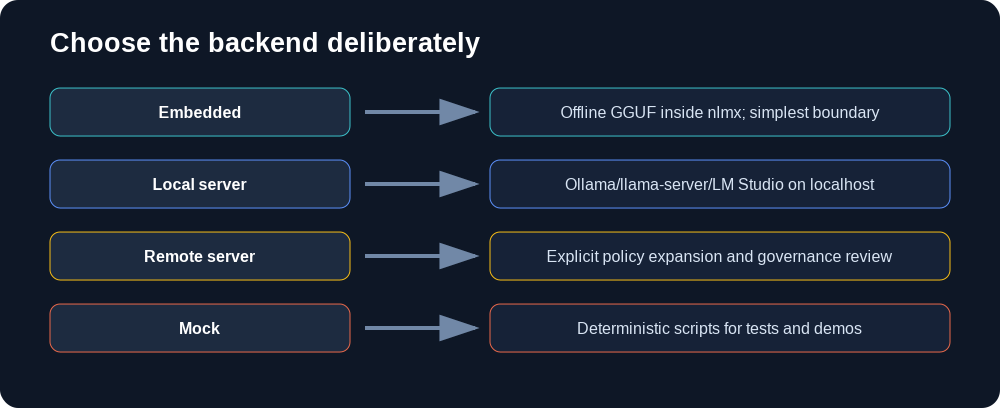
Embedded, server, and mock backends share the same nlmx protocol and guardrails but differ in where text is processed, how structured output is constrained, and how model identity is controlled. Backend qualification therefore covers more than whether a response appears.
How to use it
For privacy, inventory what enters model context: request, selected manual excerpts, command catalog, greeting metadata, explicitly read file summaries/content, and trimmed result listings. For reproducibility, pin model identity, generation settings, context size, backend version and nlmx version. Low temperature and fixed seed reduce variability but do not make free text mathematically deterministic across runtimes.
Practical interpretation
Run a versioned acceptance set and preserve raw replies plus normalized actions. Test positive cases, refusals, malformed JSON, invented options, long contexts, questions, settings saves, corrections, and unfavorable results. Evaluate whether summaries preserve signs, denominators, warnings and uncertainty.
What qualification should prove
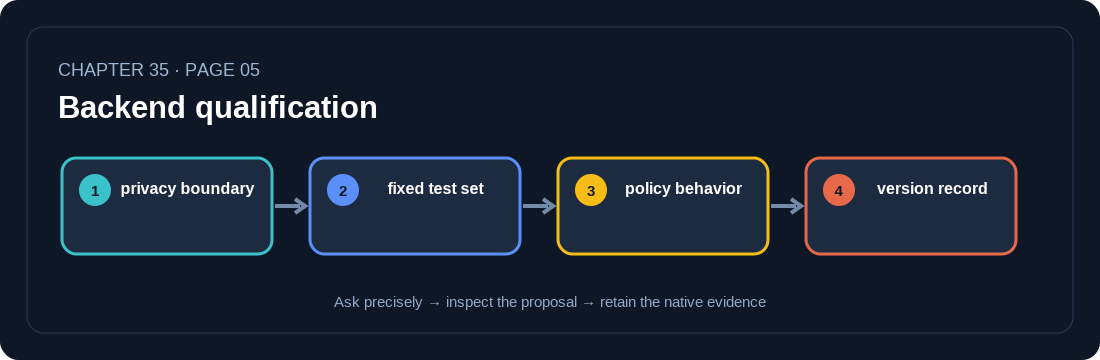
A useful protocol separates four claims. Installation qualification shows that the expected nlmx binary, runtime, model, and configuration are installed. Operational qualification shows that backend selection, grammar/JSON handling, policy checks, confirmations, timeouts, and audit artifacts behave correctly. Performance qualification uses representative project requests to show acceptable correctness and latency. Scientific validation remains command-specific and is not supplied by the assistant.
Define failures before testing: wrong command, invented setting, omitted warning, altered sign, wrong denominator, unsafe path, unapproved execution, or unrecoverable loop. Include repeat runs to estimate variability. For server backends, capture server version and model resolution; for embedded, capture the GGUF hash and build features. For every backend, preserve the exact .ask, resolved session configuration, prompt, raw event log, and review decision. Requalification depth should be proportional to the changed component and its impact.
A safe novice workflow
- Start with the narrowest backend, policy, files and command set that can answer the request.
- Name exact inputs and decisions; use guide or plan-only before granting execution.
- Inspect the normalized command and complete settings file, not only Maxson’s explanation.
- Read request end state, native command result, warnings, outputs and checksums.
- Preserve the session and record the qualified person’s interpretation and disposition.
Review and pitfalls
Mock tests validate orchestration and policy, not real-model language quality. Real-model tests validate behavior but should still avoid granting broad permissions during qualification.
- A session exit code of zero does not prove that every proposal ran or succeeded.
- Model fluency, structured JSON, and policy approval do not establish scientific validity.
- Settings and commands are reproducibility inputs; they still require versioned software and frozen data.
What to retain
Retain .ask, backend/model identity, system prompt, request, raw/normalized replies, transcript, JSONL events, settings versions, commands, child logs/outputs, checksums, exceptions, and reviewer conclusions.
Navigation
See the previous page, next page, and complete ask command and settings index.