18.25 Covariance-step overview
After estimation, the covariance step approximates uncertainty of estimated population elements \(\psi\) on their natural scale. It runs when $COVARIANCE is present or --cov-step is supplied and can be skipped explicitly.
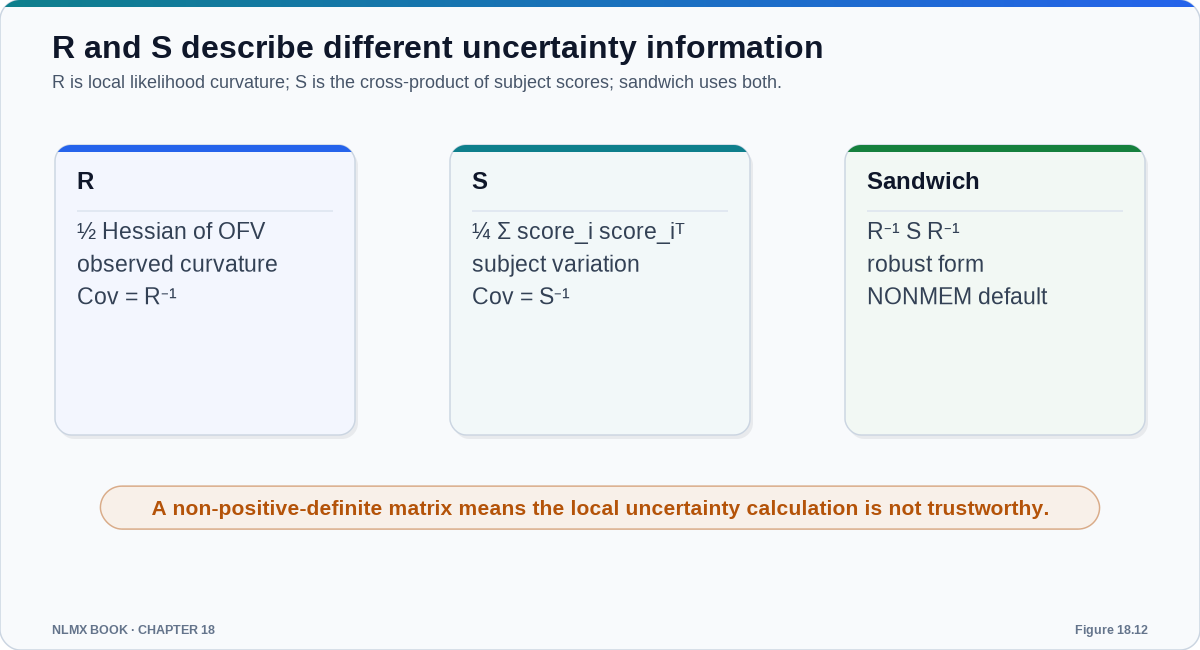
Central differences of total and subject OFVs construct the R and S matrices. The requested covariance is \(R^{-1}\), \(S^{-1}\), or sandwich \(R^{-1}SR^{-1}\). Diagonal square roots become SEs; normalization produces correlations and a condition number.
Covariance failure does not erase estimates, but it removes ordinary SE/RSE/CI support and signals flatness, boundaries, misspecification or numerical instability. It should never be hidden merely to finish a report.
Practical interpretation
Run the covariance step only after confirming the optimum is reproducible. Then archive R, S, requested covariance, parameter labels and finite-difference settings. If it fails, compare eigenvalues and boundary warnings and repeat only after a justified model or numerical change. A successful rerun belongs to a new evidence bundle, not a silent replacement.
The covariance step is not a second optimization. It describes local uncertainty around the accepted estimate. Large parameter movement during a supposed covariance calculation would indicate inconsistent implementation or that conditional modes are not being recomputed as required.
For timing comparisons, report estimation and covariance separately; the latter can dominate high-dimensional runs.
Keep the exact parameter-label order beside every matrix. An unlabeled covariance matrix is easy to misapply after a model revision, especially when fixed or tied elements change the free-parameter vector.
Common mistakes
Do not confuse the covariance of estimates with OMEGA, or assume the optimizer’s BFGS approximation is the reported covariance.
Checklist
- State covariance kind.
- Confirm natural-scale parameter order.
- Review positive definiteness.
- Report failure and boundaries.
- Compare SEs only under aligned conventions.
Further reading
Continue to R, S/sandwich, and SE reporting.