14.10 Best-fit window selection and adjusted R²
The default best-fit method tries nested terminal windows containing the last 3, 4, 5, and more eligible points after Tmax, bounded by configured minimum/maximum point counts.
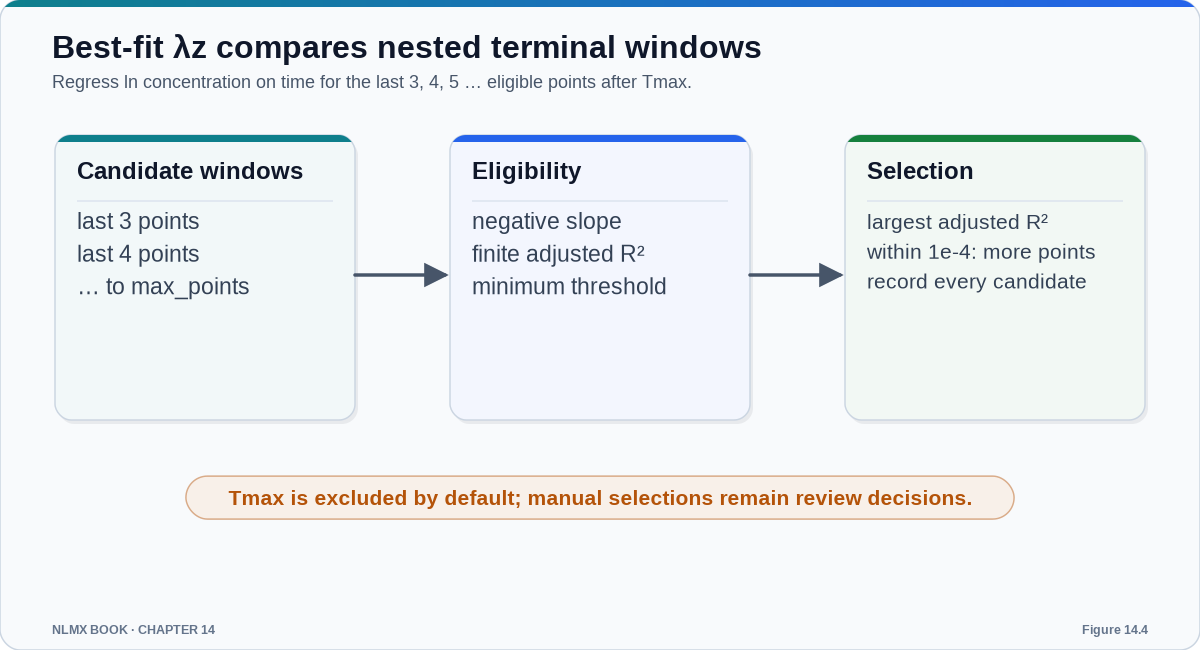
For each window it fits ln C on time. Only a negative slope (positive λz) with finite adjusted R² is eligible. Adjusted R² is
1 − (1−R²)(n−1)/(n−2)
which penalizes adding points compared with ordinary R². The candidate with largest adjusted R² wins; candidates within tolerance 1e-4 of the best are tied, and the one with more points is chosen. The automatic winner must meet minimum adjusted R² (0.7 by default).
Why nested windows
Starting from the tail and progressively adding earlier points searches for the longest well-described terminal region without arbitrary combinations. It cannot guarantee that the window is biologically terminal. A distribution point can sometimes improve adjusted R² by chance.
Every candidate should be retained in an audit table. Review n, start/end, λz, R²/adjusted R², span, and chosen status—not only the final half-life.
A reproducible tie decision
When candidates differ in adjusted R² by no more than the configured tolerance, nlmx treats them as effectively tied and prefers the window with more observations. This prevents insignificant floating-point variation from choosing a shorter line. A validator should create an explicit near-tie fixture because ordinary examples may never exercise the rule.
Eligibility also changes enumeration. Removing a BLQ, zero, excluded observation, or Tmax point changes the entire nested sequence. Compare actual point times and identifiers before comparing candidate numbers across programs.
Common mistakes
- Choosing ordinary R² when the method specifies adjusted R².
- Ignoring the tie tolerance and point-count rule.
- Comparing non-nested arbitrary windows to the automatic algorithm.
- Assuming the mathematically best line is biologically terminal.
Checklist
- Enumerate all candidate windows.
- Verify negative slope and minimum fit threshold.
- Reproduce adjusted R² and tie handling.
- Inspect the chosen line on the profile.
- Preserve all candidates and the reason.
Further reading
See manual selections, diagnostic flags, and the csvworked candidate table.