Chapter 8. The model engine
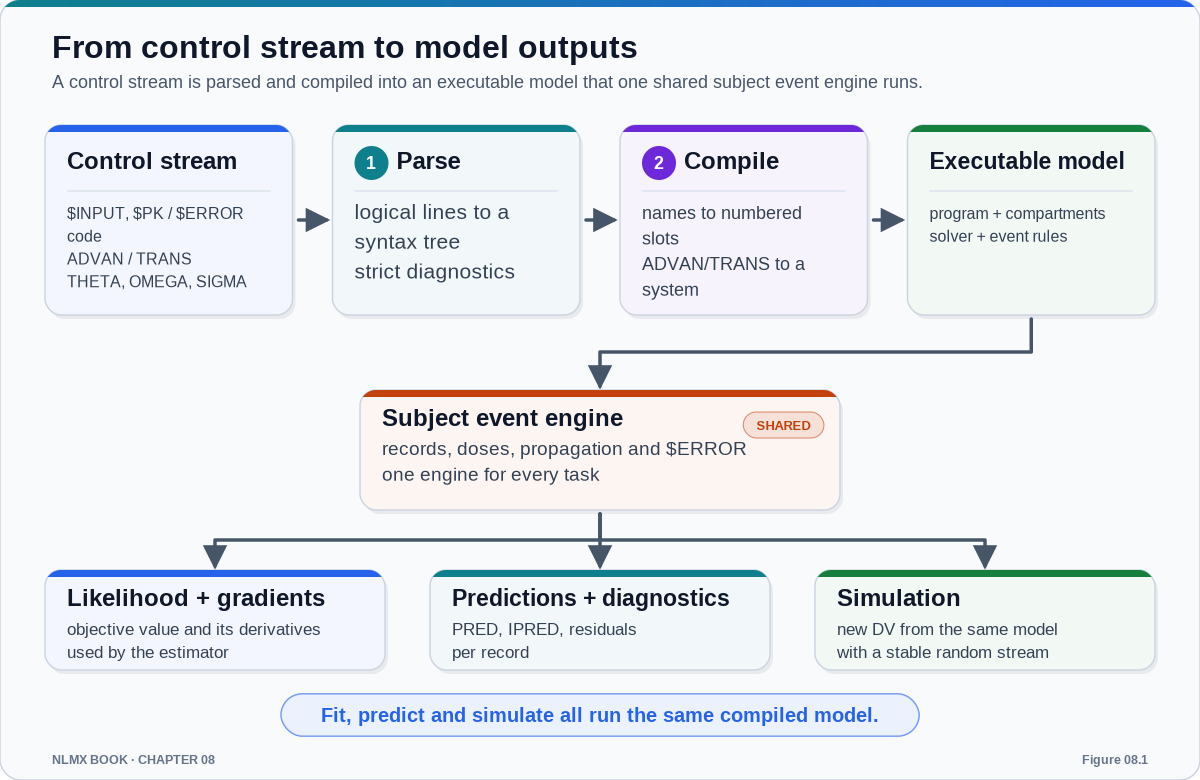
The model engine is where a control stream becomes predictions, derivatives, likelihood contributions and simulated observations. Reproducing another pharmacometrics program requires more than accepting familiar syntax: the parser, compartment mapping, event ordering, solver, scaling and error model must agree at every record.
What you will learn
- how nlmx normalises, parses, resolves and executes abbreviated NM-TRAN code;
- which ADVAN/TRANS families, statements, functions and special variables are implemented;
- how analytic, matrix-exponential, Michaelis–Menten and
$DESsystems advance amounts;- how doses, infusions, lags, bioavailability, additional doses, steady state and resets are ordered;
- where forward-mode automatic differentiation is exact and where finite differences remain;
- how model simulation and likelihood evaluation share the same event engine;
- how to validate engine accuracy without overgeneralising from one fixture.
Prerequisites. Read Chapter 5 for control-stream structure, Chapter 6 for record semantics and Chapter 7 for reproducible settings and evidence.
Version scope and evidence
Behavior was checked against the model engine (NM-TRAN interpretation, PK solvers, likelihood and automatic differentiation). Executable evidence in documents/ch08 was produced with release 4.3.0 and is labelled accordingly.
pytools/ch08_examples.py fits the same one-compartment oral model as ADVAN2 and ADVAN13, compares both against the closed form at eight times, and captures an intentional unsupported-syntax failure. The maximum absolute errors were \(4.44\times10^{-16}\) for ADVAN2 and \(1.19\times10^{-11}\) for the ODE fixture.
Twenty pages in this chapter
| Page | Topic |
|---|---|
| 8.1 | From control stream to executable model |
| 8.2 | Source normalisation, lexing and names |
| 8.3 | Expressions, operators and functions |
| 8.4 | Statements, branches, loops and special variables |
| 8.5 | Unsupported constructs and diagnostic boundaries |
| 8.6 | ADVAN/TRANS support matrix |
| 8.7 | Parameter mappings, compartments and scaling |
| 8.8 | Analytic and matrix-exponential propagation |
| 8.9 | General linear models with ADVAN5/7 |
| 8.10 | $DES models and solver selection |
| 8.11 | ODE tolerances, error control and stiffness |
| 8.12 | Subject timelines and record execution |
| 8.13 | Bolus, infusion, lag and bioavailability |
| 8.14 | ADDL, steady state, resets and model events |
| 8.15 | Predictions, residual error and likelihood records |
| 8.16 | Forward-mode automatic differentiation |
| 8.17 | Simulation from the compiled model |
| 8.18 | Worked analytic-versus-ODE verification |
| 8.19 | Accuracy boundaries and review checklist |
Continue with the compilation and execution pipeline.