15.28 Worked example: steady-state oral interval
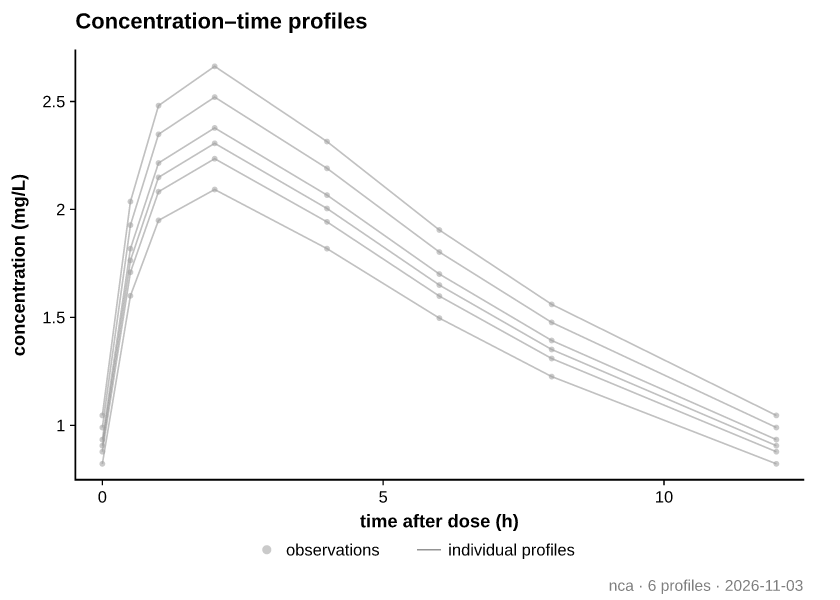
This fixture contains six subjects at oral steady state after 100 mg every 12 hours. Each SS dose row has II=12 and SS=1; observations cover 0 through tau.
Files:
What to verify
All six rows should have STEADY_STATE=1 and TAU=12. For subject 1, the frozen output gives AUCtau about 17.478, Cavg about 1.456, Cmax about 2.092, and Ctau/Cmin about 0.822. Cavg equals AUCtau/12; this is a direct hand-check of timing and units.
The profile begins with residual concentration rather than an inserted zero, reflecting steady-state accumulation. Fluctuation is calculated from Cmax, Cmin, and Cavg. Apparent steady-state clearance appears in CL_F_SS, not CL_SS, because administration is extravascular.
The fixture intentionally receives LZ_SPAN_SHORT for terminal estimates because a 12-hour interval covers less than the default two half-lives. AUCtau remains useful even though the terminal span is flagged. This illustrates why flags should be traced to dependent quantities rather than used to discard every parameter in the row.
Sensitivity exercises
Rerun with --steady-state none: interval-specific fields should change or become unavailable because the profile is no longer classified as steady state. Rerun with an incorrect --tau 24 only as a training exercise and observe that Cavg changes; this demonstrates why tau is an analysis input, not a harmless label.
Common mistakes
- Adding zero at the steady-state dose and erasing residual concentration.
- Reading
CL_SSinstead ofCL_F_SSfor oral dosing. - Rejecting AUCtau solely because lambda-z span is short.
- Supplying tau in a different time unit.
Checklist
- Confirm SS, II, tau, and boundary sample.
- Recalculate Cavg.
- Compare Cmin and Ctau definitions.
- Read the route-appropriate clearance field.
- Interpret terminal flags separately from interval exposure.
Further reading
See analysis settings, steady-state columns, and steady-state theory.