Chapter 23A — Stepwise covariate selection with cov
Stepwise covariate modelling (SCM) is nlmx's refit-based selection engine. It builds nested covariate models, re-estimates their free parameters, compares optimized objective functions with likelihood-ratio tests, and uses prespecified forward and backward thresholds to decide which relationships enter or leave. It is slower than the Chapter 23 frozen-score engine, but it asks the more complete conditional question: what evidence remains after the population model is allowed to adjust?
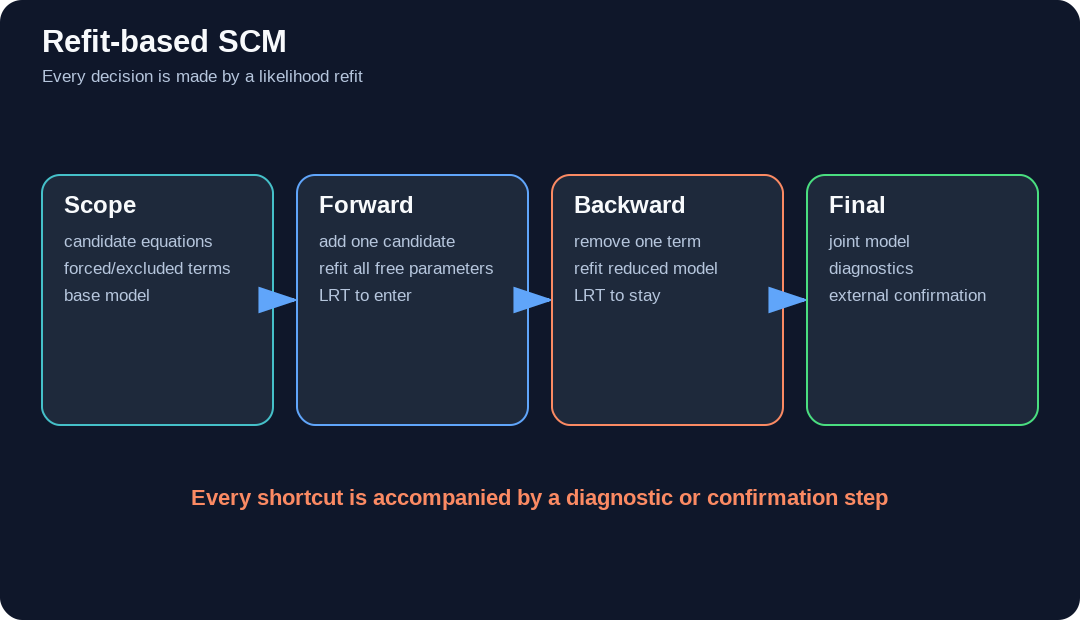
This chapter is a novice-first and audit-ready reference for nlmx cov --method scm. It explains the likelihood comparison, degrees of freedom, nested-model requirements, warm starts, convergence, forward inclusion, backward elimination, both-direction search, equation forms, forced/excluded relationships, correlated covariates, candidate caps, caches, resume, final refitting, outputs, PsN/NONMEM differences, and validation. The complete command and settings index lists every SCM-specific control and every shared cov option that can materially affect the run.
Verified worked evidence
Five nlmx 4.8.0 runs are preserved under documents/ch23a: accelerated both-direction search, exhaustive both-direction search, exhaustive forward-only search, backward-only search, and a stricter-threshold sensitivity. The scope contained three simulated true relationships—CL–WT, CL–EGFR, and V–WT—and two null SEX relationships. Every search direction and threshold sensitivity retained the same three true effects and rejected both null effects. The accelerated and exhaustive paths reached the same final OFV (−1157.8135) and coefficients.
That agreement is a verification example, not a universal accuracy claim. The chapter repeatedly marks the conditions under which nominal LRT evidence, score-ranked acceleration, backward full-model starts, and cross-software comparisons can fail.
How to read this chapter
New users should read pages 23A.1–23A.16 in order, then follow the worked pages 23A.32–23A.35. Experienced modelers can begin with search directions, candidate caps, failures, outputs, or the complete validation checklist.
SCM selects a statistical model within a declared search space. It does not establish causality, clinical importance, dose-adjustment policy, or software equivalence by itself.