Search directions: forward, backward, and both
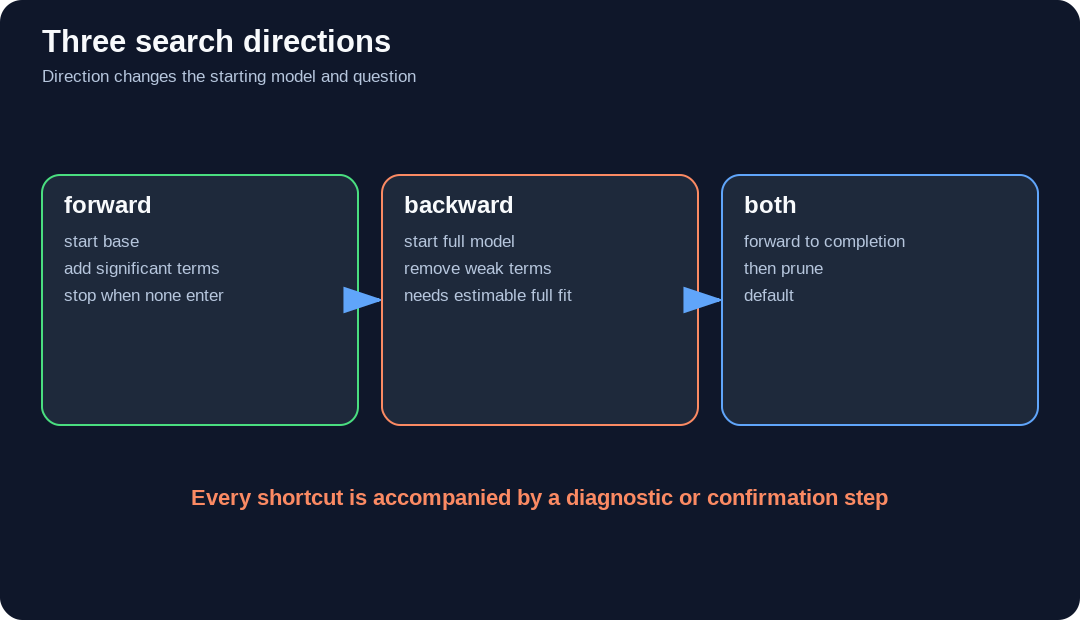
--scm-direction forward starts with the base/forced model and adds the best significant relationship until no eligible candidate enters. backward starts from a fitted full model containing one selected equation for every eligible relationship, then removes the weakest dispensable term. both, the default, completes forward inclusion and then audits that endpoint by backward elimination.
These are different algorithms, not interchangeable display preferences. Forward search can avoid fitting an unstable full model but may never admit a relationship that becomes important only jointly. Backward search evaluates conditional retention from the richest model but can fail or behave erratically when that model is over-parameterized. Both-direction search can remove a term whose significance vanished after later additions, yet it still inherits the forward path.
Predefine the primary direction. Use alternative directions as sensitivity analyses and explain endpoint disagreements through correlation, form choice, convergence, or threshold behavior rather than selecting the most attractive endpoint after the fact.
Common mistakes
- Treating a stepwise p-value as clinical importance or causal proof.
- Reading a candidate comparison without its active model, convergence state, degrees of freedom, and exact threshold.
- Reporting only the terminal relationship list while discarding failed models, path decisions, configuration, and provenance.
Page checklist
- The scientific question, model identities, and comparison direction are explicit.
- Numerical validity is reviewed before interpreting statistical evidence.
- The result is linked to the complete trace and final joint-model diagnostics.