8.15 Predictions, residual error and likelihood records
For compartment models, F is the selected compartment amount divided by its scale. $ERROR receives F, amounts, data, parameters and persistent locals, and must assign Y. With $ERROR (OBS ONLY), non-observation records skip error evaluation; otherwise $ERROR can run on other record types while only observations contribute outputs.
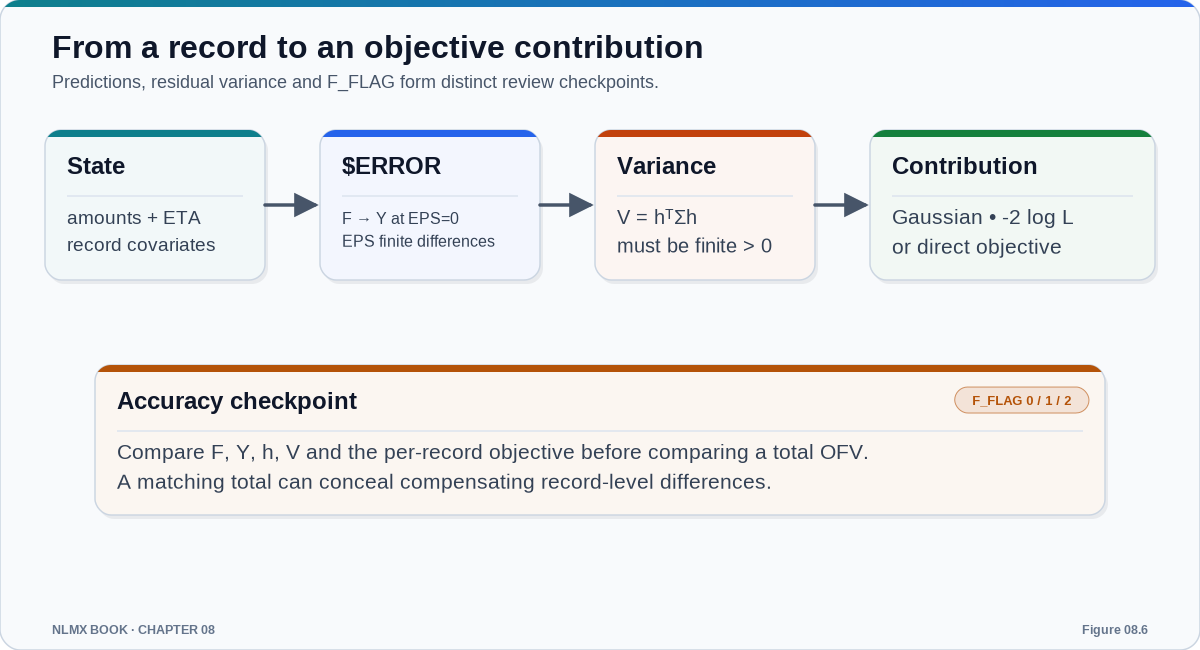
Figure 8.6. State propagation, $ERROR, residual variance and F_FLAG are separate checkpoints. Compare them record by record before attributing a total-objective difference to the optimizer.
Residual variance
At estimation, $ERROR is evaluated at EPS=0. nlmx obtains \(h=\partial Y/\partial EPS\) using symmetric finite differences, then calculates
This is exact for ordinary additive, proportional and combined models that are linear in EPS. Nonlinear EPS transformations are approximated at zero and require step-sensitivity checks. The EPS step is \(10^{-3}\max(\sqrt{|\sigma_{kk}|},10^{-6})\).
For Gaussian records, the objective contribution is
Nonpositive or non-finite residual variance fails with a hint, commonly exposing a proportional-only model at zero prediction.
F_FLAG
F_FLAG=0 uses the Gaussian contribution. F_FLAG=1 treats positive Y as a likelihood and contributes -2 log(Y), as in M3 censoring. F_FLAG=2 treats Y as a direct objective contribution. Other values are unsupported. Likelihood records require the Laplace approximation in the fitting workflow.
Conditional objectives
The subject objective adds the ETA prior \(\eta^T\Omega^{-1}\eta\). FO, FOCE, FOCE-I and Laplace differ in linearisation point, residual-variance evaluation and curvature adjustment. The model engine supplies predictions and derivatives; Chapter 18 will cover estimation theory in depth.
Common mistakes
- Calling EPS derivatives automatic differentiation; they are symmetric differences.
- Using a proportional-only error at an exact zero prediction.
- Simulating an
F_FLAGlikelihood model as thoughYwere an observation.
Checklist
- Derive
F,Y, EPS derivatives and variance separately. - Verify
F_FLAGon every special record. - Match likelihood approximation across software.
Further reading
See automatic differentiation, simulation limits and Chapter 18's planned likelihood theory.