18.23 Termination and convergence evidence
nlmx stops when maximum absolute transformed gradient is below the configured tolerance (default (10^{-3})), when relative OFV change stays below (10^{-9}) for three iterations, or when a failure/iteration limit intervenes. The termination message identifies the rule.
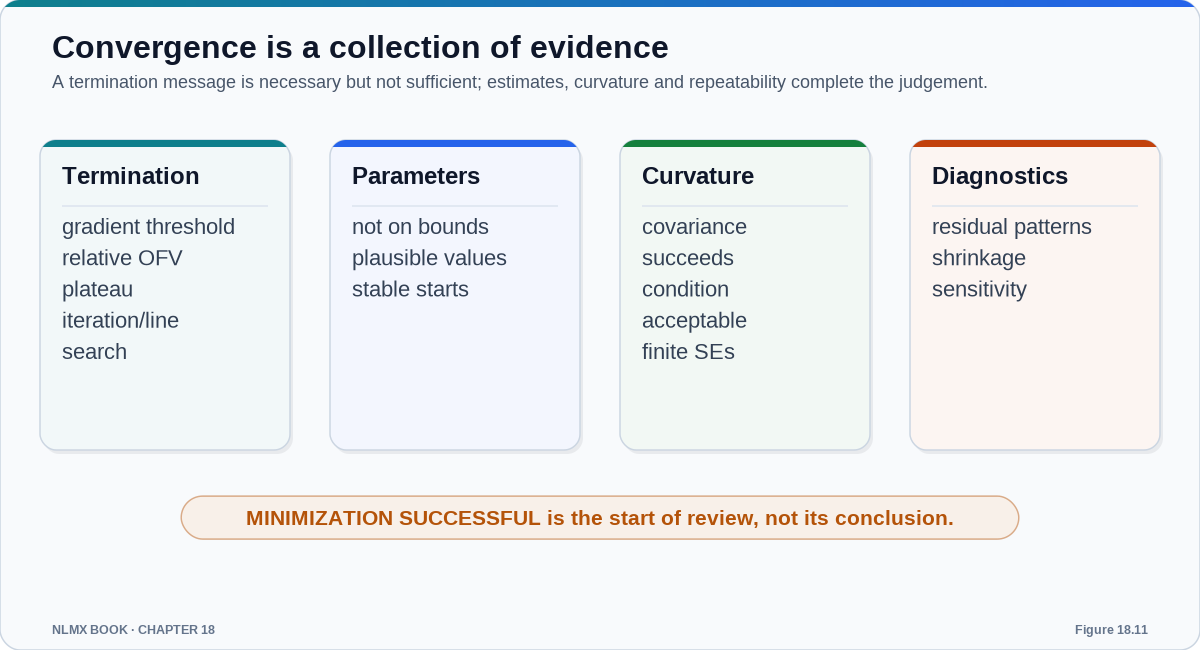
Successful termination is necessary but insufficient. Review parameter plausibility, boundaries, conditional-mode success, covariance, condition number, high correlations, stability across starts and diagnostic plots. An OFV plateau can arise from a flat unidentified direction; a small transformed gradient can coexist with awkward natural-scale sensitivity.
Iteration limit means the requested search did not finish. Increasing it helps only if the trajectory continues coherently. A line-search failure with large gradient suggests a poor basin, nonsmooth objective or numerical error.
Practical interpretation
Use a convergence worksheet with five rows: termination, gradient/OFV trace, parameter boundaries, covariance/conditioning, and restart agreement. Require a reviewer comment for each. This avoids collapsing a multidimensional judgement into one status word and produces a consistent audit trail across nlmx, NONMEM and other software.
Add a sixth row for scientific diagnostics: parameter plausibility and residual/predictive behavior. Numerical convergence at a misspecified model is still a successful optimization of the wrong likelihood.
For batch screens, automated gates can triage results, but pivotal fits require manual review of the underlying evidence. Store the raw messages, not only a derived pass/fail flag.
The final report should state unresolved convergence limitations prominently rather than burying them in a log appendix.
Common mistakes
Do not report “converged” from a single success string, suppress warnings, or tune tolerances until a preferred estimate is accepted.
Checklist
- Record termination rule, iterations, evaluations and gradient.
- Check all subject modes.
- Examine boundaries and covariance.
- Repeat from independent starts.
- Require diagnostic plausibility.
Further reading
Read starts and local optima and covariance overview.