39.13 Exit code 11: checkpoint or resume incompatibility
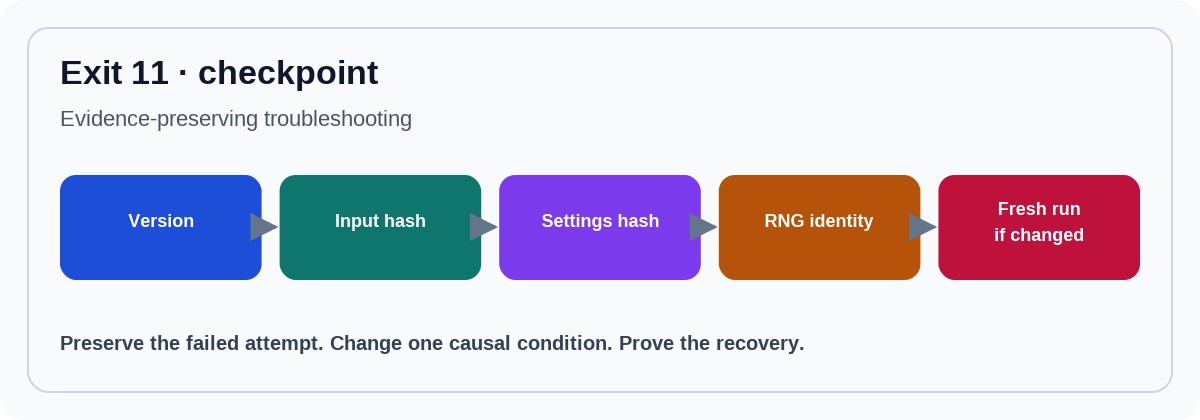
What you will learn
- Understand checkpoint identity
- Restore exact state or start fresh
- Never edit metadata to force a resume
Prerequisites: Chapter 36 exit-code reference, Chapter 38 output completion, and the Chapter 39 overview.
This page describes nlmx 4.16.2. Troubleshooting must preserve the failed attempt: keep its exact command, working directory, log, resolved settings, input/model identities, partial outputs, and process exit code. Correct one causal condition at a time and compare the new evidence with the failed run. Never convert a nonzero exit into success in a wrapper, and never interpret exit 0 as scientific acceptance without the command-native verdict.
Exit 11 prevents a saved computation from being resumed under a different identity. Checkpoints can bind software/schema version, RNG derivation, method, normalized settings, inputs/model artifacts, feature/candidate definitions, and completed replicate state. Resuming after any material change would mix incompatible evidence.
Compare the checkpoint manifest with the intended executable, version, input hashes, settings hash, seed/RNG derivation, threads contract where applicable, and output root. Restore exact files only from controlled storage. If the analysis intentionally changed, create a new run and describe the old checkpoint as abandoned evidence.
Never edit a checkpoint JSON/binary header or copied hash to force acceptance. Even if deserialization succeeds, statistical denominators, random streams, features, or algorithms may differ. A corrupt/incomplete checkpoint should be preserved for diagnosis but not repaired by guessing missing state.
After a valid resume, reconcile the combined run: no duplicate/missing replicate IDs, preserved seeds, expected total count, identical completed-prefix results, and final checksum/status. Test resume behavior during qualification by interrupting a controlled fixture and comparing the resumed output with an uninterrupted run.
Page checklist
- Did you retain the exact exit code, stage, message, hint, log, and partial output?
- Did you identify one causal layer before changing anything?
- Is the recovery a new, traceable attempt with the same intended estimand?
- Did you check command-native and scientific acceptance after process completion?
Navigation
See the previous page, next page, and complete error reference.