12.18 Correction philosophy and complete catalogue
By default, qc-nm checks the original control stream, applies enabled corrections to a new copy, then checks that copy again. It never overwrites the source. This design lets you compare before and after, but it does not convert a suggestion into an approved scientific change.
All correction names
The current --list-checks catalogue exposes 24 correction names. “Default” below means enabled unless configuration or command options change it.
| Area | Correction | Default | Purpose in brief |
|---|---|---|---|
| File | ascii, line_endings, tabs, trailing_space, wrap_lists |
on | Normalize text and long lists. |
| Records | problem, sizes_first |
on | Add/position structural records. |
| Records | record_names |
off | Expand abbreviated record names. |
| Input | input_from_header |
off | Rebuild input labels from a header. |
| Input/data | drop_text, ignore, tol |
on | Handle text, header skipping, and tolerances. |
| Parameters | bounds, zero_fix, block_pd |
on | Repair recognizable parameter defects. |
| Estimation | interaction, maxeval, posthoc |
on | Add commonly required estimation options. |
| Estimation | covariance |
off | Add a covariance step. |
| Tables | table_files, table_options |
on | Make filenames/options safer. |
| Tables | table_items, ignore_numeric, table_unused |
off | Rewrite table items or advanced selection/use cases. |
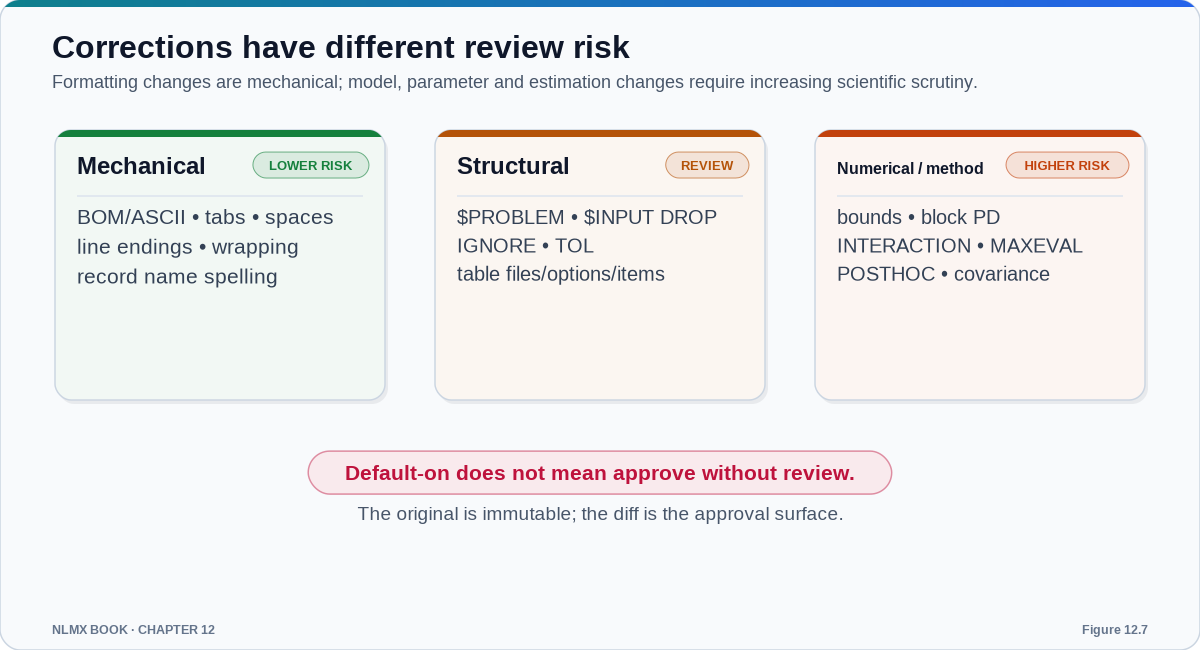
The off-by-default group deserves extra care because it can infer intent or alter broader behavior. Even default-on corrections may affect analysis semantics: ordering bounds, fixing a zero variance, adding INTERACTION, or changing header selection all require review.
Safe acceptance workflow
Read qc_nm_changes.csv, inspect qc_nm_changes.diff, review the corrected control stream in context, then execute and validate it. Commit the reviewed source through your normal version-control process rather than silently substituting the generated file.
Common mistakes
- Assuming “enabled by default” means regulatorily or scientifically approved.
- Accepting all changes because the after-fix verdict is READY.
- Editing only the generated copy and losing the rationale in source control.
- Forgetting that correction defaults may change between nlmx versions.
Checklist
- Record the nlmx version and exact correction selection.
- Preserve the original file and generated evidence.
- Review every diff hunk with a modeler.
- Run NONMEM and compare numerical outputs.
- Document accepted and rejected changes with rationale.
Further reading
See correction controls, reading changes, and worked example.