12.7 $INPUT mapping checks: INP01–INP08
$INPUT maps dataset fields by position. INP01–INP04 validate names, uniqueness, required ID/DV (plus TIME/AMT for PREDPP) and reserved words. INP05 forbids code use of DROPped items. INP06 reports EVID/MDV inference. INP07 compares labels with the header; INP08 requires text fields to be DROPped.
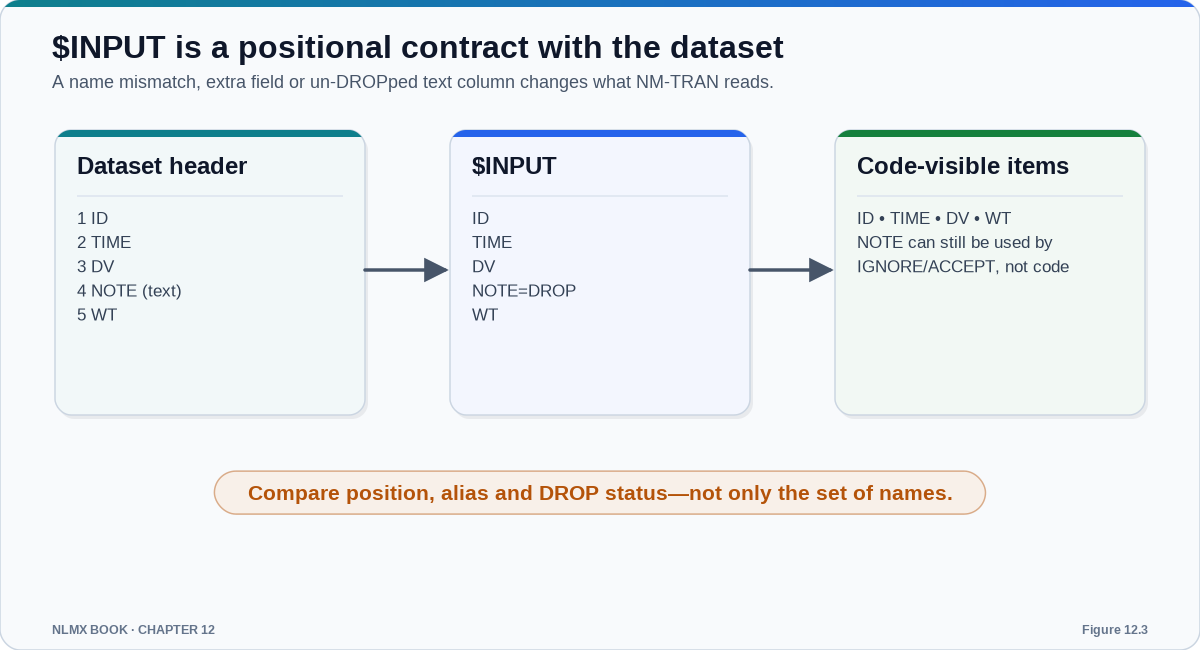
Figure 12.5. Header and $INPUT must agree by position, including aliases and DROP status.
Text columns
A text NOTE column may remain in the physical dataset only when $INPUT marks it DROP and abbreviated code does not use it. It can still participate in some IGNORE/ACCEPT selection because selection occurs at the data interface.
input_from_header is default-off because rewriting the interface is structurally consequential. drop_text is default-on only for detected text columns unused by code. Review both against the transfer specification.
Investigation
Create a position table: index, header name, $INPUT token/alias, DROP status, code use and expected type. This reveals shifted columns that name-set comparisons miss.
For example, if the physical header is ID,TIME,WT,DV but $INPUT says ID TIME DV WT, all four names exist while the last two positions are reversed. The model may then treat weight as an observation and the observation as a covariate. INP07 is designed to reveal this interface mismatch, but the reviewer should still compare a few raw rows and units. Aliases such as CONC=DV also need two meanings recorded: the physical column label and the NONMEM data-item name used by code.
Common mistakes
- Comparing names without positions.
- DROPping text that code or intended filtering requires.
- Assuming EVID/MDV inference matches every tool.
- Enabling full header rewrite without diff review.
Checklist
- Reconcile every position and alias.
- Verify required items for the chosen model type.
- Review inferred event flags explicitly.
- Confirm text/DROP handling.
Further reading
See dataset header mapping, input corrections and $DATA checks.