IDs and Seeds
How identifiers are recoded (--id-style) and what the random seed (--seed) controls. Two options, one page, because
they interact: the seed changes some codes and not others.
1. Identifier recoding
Every identifier column (ID, subject, study, site, user) and every label column (treatment, sex, race, country) is
recoded with a code book: each distinct original value gets one code, and the same value always gets the same code
within a run. The book is written to keymap.txt so that reverse can turn the codes back into the originals.
data-obfuscator run --input pk_study.csv --output ./masked --level 1 --seed 2026 --id-style padded
2. The three ID styles
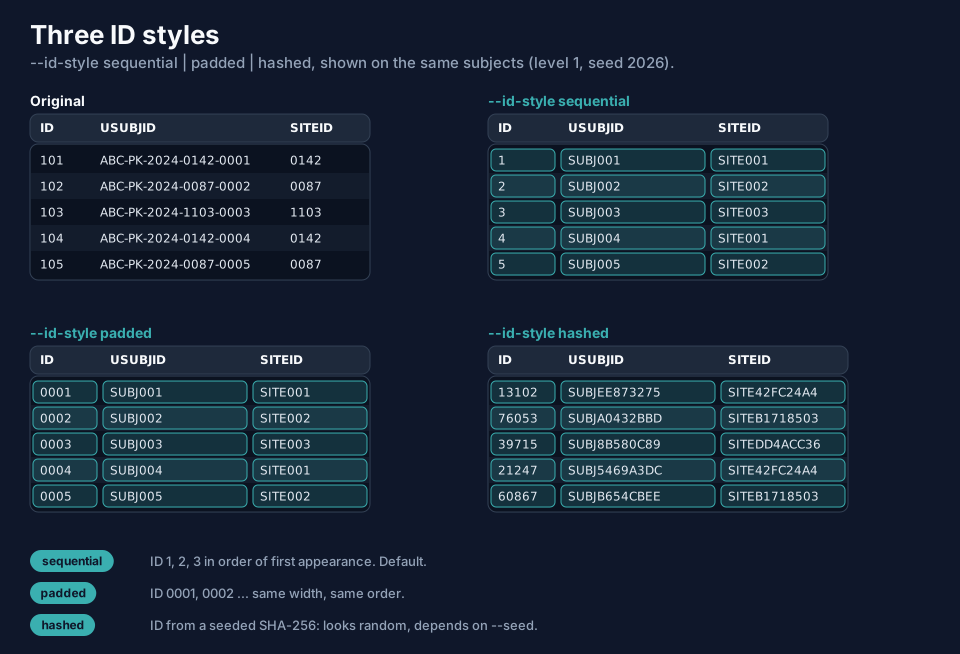
| Style | ID column |
Other recoded columns | Use it when |
|---|---|---|---|
sequential (default) |
1, 2, 3, ... in order of first appearance |
SUBJ001, STU001, SITE001, USER001; treatments ARM_A, ARM_B, ...; races CAT001; countries C001 |
you want short, readable codes |
padded |
0001, 0002, ... (same width) |
same as sequential | a fixed-width ID is needed (a NONMEM $INPUT that expects it, for example) |
hashed |
a 5-digit number from a seeded SHA-256 of the value (10000 to 99999) | prefix plus 8 hexadecimal characters: SUBJEE873275, SITE42FC24A4 |
the order of codes must not reveal the order of the file |
Two consequences worth knowing:
- Sequential and padded codes reveal the order in which subjects first appear in the file. If the file is sorted by
enrolment date, subject
1is the first enrolled. Usehashedwhen that matters. - Hashed codes depend on the seed, so they differ from run to run unless you fix it. Two subjects that share a site
get the same site code (look at
SITE42FC24A4twice in the figure).
The same rules apply to every dataset of a run2, with one shared table per identifier kind (page Masking Several Datasets: run2).
3. What the seed controls
--seed N (default 42) is the only source of randomness in a run.
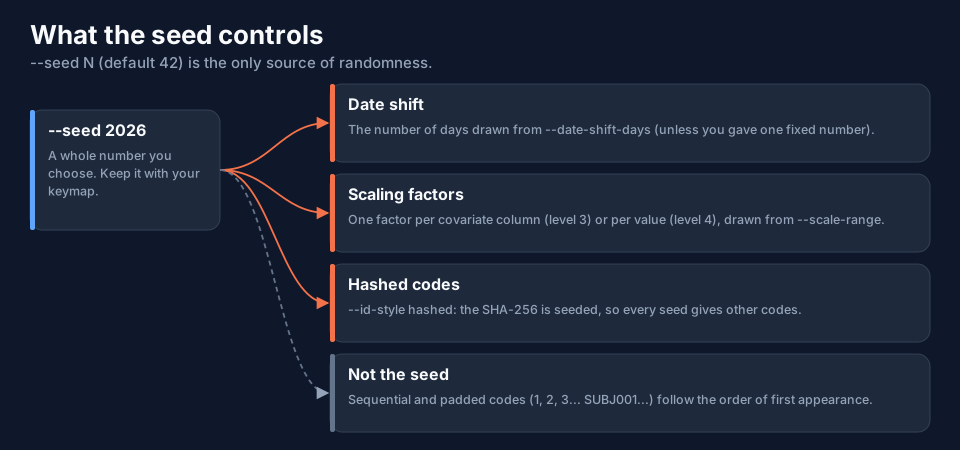
| Part of the masking | Depends on the seed? |
|---|---|
| the date shift (when drawn from a window) | yes |
| the scaling factors (level 3 and 4) | yes |
hashed codes (--id-style hashed) |
yes |
| sequential and padded codes | no: order of first appearance |
a fixed date shift (--date-shift-days 23.6) |
no: you gave the value |
The same data under three seeds
Level 3 with --id-style hashed, seeds 1, 99 and 2026:
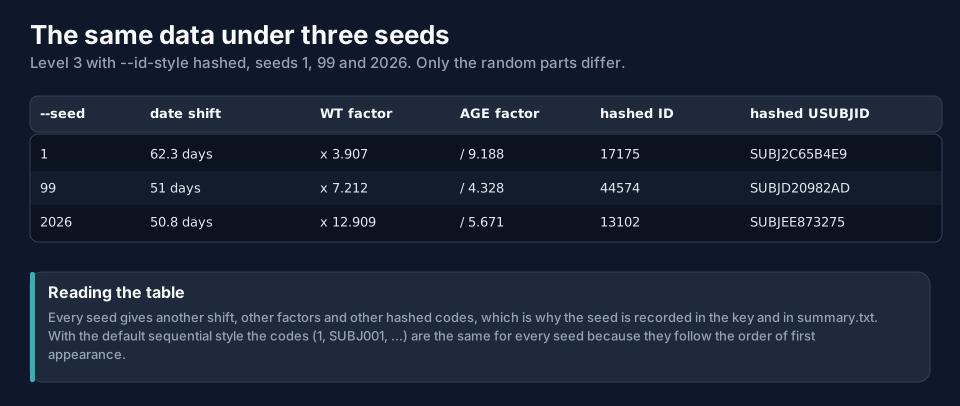
Read across a row: with seed 1 the dates move by 62.3 days, WT is multiplied by 3.907 and AGE divided by 9.188; with
seed 2026 the shift is 50.8 days, WT is multiplied by 12.909 and AGE divided by 5.671. The hashed ID of the first
subject changes as well (17175, 44574, 13102).
4. Reproducible runs
Same input file + same options + same seed + same program version = a byte-identical dataset. The proof is the
SHA-256 fingerprint printed at the end of each run and written in summary.txt.
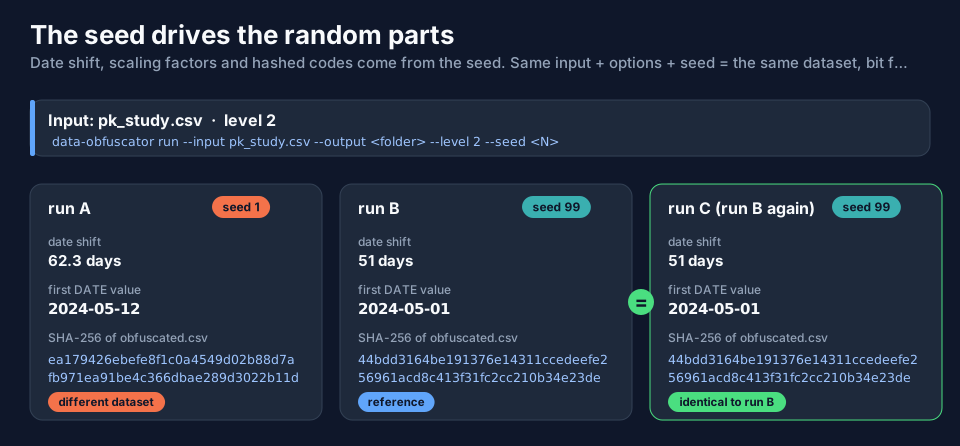
Try it: run the same command twice into two new folders and compare the files.
data-obfuscator run --input pk_study.csv --output ./run_a --level 2 --seed 99
data-obfuscator run --input pk_study.csv --output ./run_b --level 2 --seed 99
The two obfuscated.csv files are identical (and so are the SHA-256 lines in the two logs). With --seed 1 instead of
99 the date shift is 62.3 days and the file is different.
5. Choosing a seed
- Choose your own number (
--seed 20261012). The default 42 is known to everybody, which makes the date shift and the factors guessable for anyone who knows the data were masked with defaults. - Write it down with the key: the seed is recorded in
summary.txtandconfig.used.txt, and the key (keymap.txt) holds the actual shift and factors, so a lost seed does not stop a restore. - A different masking on every run: in an options file write
seed = auto; the program draws a seed and records it insummary.txt. Keep that file (privately) if you ever need to repeat the run. - Changing the program version can change the result for the same seed (the version is part of the reproducibility statement), so keep the archive of the version you used for work you must repeat.
Next
Dates and Free Text describes the date shift in detail, including the formats it understands.