Data Obfuscator
Real data should not be shared with LLM not hosted in your organization. And yet an LLM is the fastest route to a clean NONMEM control stream, a first exploratory plot or a thorough check of your data. Data Obfuscator gives you both. With one offline command it replaces every subject, study and site identifier, moves the calendar, hides labels and free text and, when you ask for more, disguises the covariates, while the doses, times, concentrations and event flags that your model depends on stay exactly as they were. The LLM works on a dataset that behaves like yours; the real values never leave your computer, and one more command puts them back when the answer comes home.
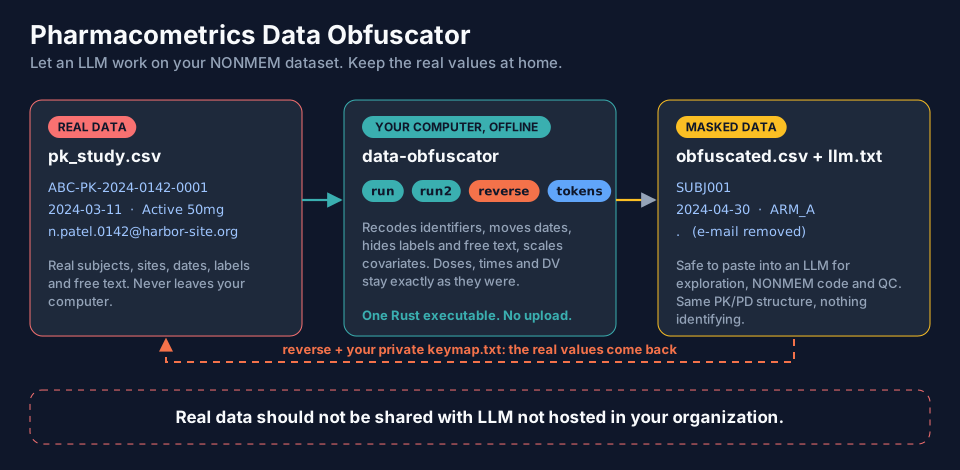
It is a single, offline command-line program written in Rust: no installer, no cloud, no upload. The data are read from a file on your computer and the masked copy is written next to it. The same input, options and seed always give a byte-identical result, so a masking can be repeated and audited.
The problem it solves
Pharmacometric datasets carry real subject, study and site identifiers, real calendar dates, covariates that can single out a person, and free text. An LLM is very useful for exploratory analysis, NONMEM control streams and data quality control, but the raw file cannot simply be pasted into it. Scrubbing the file by hand is slow and easy to get wrong, and a careless scrub often damages exactly what the analysis needs: the order of times within a subject, the dosing records, the observations, the event flags.
What it does, in one picture
 real dataset  ──►  data-obfuscator  ──►  masked dataset      share it
 (pk_study.csv)                      ──►  llm.txt             share it (prompts built for this dataset)
                                     ──►  tokens.txt          for you (how big is it for GPT, Claude, Gemini ...)
                                     ──►  keymap.txt          KEEP PRIVATE (the key that undoes the masking)
The masked dataset keeps doses, observations (DV), times (TIME, TAD), event flags (EVID, MDV, CMT, RATE,
ADDL, II, SS, DVID, ...) exactly as they were. What changes is what identifies: identifiers are recoded,
dates are moved by a constant, covariates can be rescaled, free text is removed.
The four commands
| Command | Purpose |
|---|---|
run |
Mask one dataset. Writes the masked file, llm.txt, tokens.txt, the private key and a record of the run. |
run2 |
Mask several related datasets together (for example CDISC ADaM ADSL, ADEX, ADPC, ADLB) with shared codes, so an LLM can combine them into one NONMEM-style master dataset. |
reverse |
Undo the masking with the private key: restores a masked dataset, or the combined dataset an LLM built from run2 files. |
tokens |
Estimate how many tokens a file would use in the main LLM families, before you paste it. |
Typical workflow
- Mask:
data-obfuscator run --input pk_study.csv --output ./masked --level 2 - Check the warnings the program prints and read
masked/summary.txt. - Share only
obfuscated.csvandllm.txtwith the LLM or collaborator. Keepkeymap.txt,summary.txt,config.used.txtandobfuscator.logto yourself. - Work with the LLM on the masked data: exploration, a NONMEM control stream, QC.
- Restore when you need the real values:
data-obfuscator reverse --input table_from_llm.csv --keymap masked/keymap.txt.
Who it is for
Clinical pharmacologists, pharmacometricians and data scientists who want an LLM's help on clinical PK/PD data without handing over the real identifiers.
What it is not
Masking lowers the risk of re-identification; it is not formal anonymisation. Unusual covariate combinations, rare dates or rare events can still identify someone. The program prints warnings for the problems it can detect, but the decision to share a dataset stays with you and your organisation's rules.
Where to go next
| Read | For |
|---|---|
| Features at a Glance | what the program can do, at a high level |
| How It Works | one dataset followed step by step, with figures |
| Workflows and Safety | the two main workflows, which command and level to choose, what may be shared |
| Key Options at a Glance | the options you will use most |
| Using the Program (fourteen more pages) | one page per command and group of options, each with tested examples, real output and downloadable files |
| Version & Purpose | how versions work and why each release exists |
| Author, License and Citation | who wrote it, how to cite it, and the license it is shared under |
README.md and CONFIGS.md (project folder) |
the complete reference |