Software that scales with the science of drug development

HyperPKPD builds practical tools for pharmacometricians, clinical pharmacologists and data scientists: PK/PD modeling without NONMEM, safe sharing of NONMEM datasets, and an interactive way to learn PK/PD. Use the free apps on this website, or ask for apps and tools to be deployed on-premises.

hyperpkpd — terminal
# Data Obfuscator: mask one NONMEM-style dataset
$ data-obfuscator run --input pk.csv --output ./masked

# ...or several ADaM / SDTM domain datasets together
$ data-obfuscator run2 \
    --input adsl.csv --input adex.csv --input adpc.csv \
    --level 3 --output ./masked_adam
$ data-obfuscator run2 --input ./sdtm --output ./masked_sdtm

# nlmx: check the dataset before modelling
$ nlmx qc-data data/analysis.csv

# fit the model and draw the figures
$ nlmx fit models/run101.ctl --plots

# check it by simulation (pcVPC + NPC)
$ nlmx vpc models/run101.ctl
$ 

Tools for real pharmacometric work

Fast, offline, reproducible programs, plus next-generation, highly usable interfaces that connect your tools and make every workflow more efficient. Built for Clinical Pharmacology, Pharmacometrics and Data Science teams.

Data Obfuscator

data-obfuscator

Mask a NONMEM-style pharmacometric dataset, or several CDISC ADaM and SDTM domain datasets together, so they can be shown to an LLM or a collaborator without breaking the PK/PD structure that makes the data worth analysing. A single offline program with no network code.

  • Recodes identifiers, shifts dates, rescales covariates and optionally renames columns
  • Leaves doses, observations, times and event flags exactly as they were
  • Four masking levels, deterministic and reproducible with a seed
  • Writes a ready-to-paste LLM prompt pack, token estimates, and a private key that lets you reverse the masking

Not formal anonymisation and not encryption: review its warnings and keep your keymap file private.
Outputs

masked dataObfuscated NONMEM-style dataset
llm.txtPrompts to analyse the data, build a control stream and run QC, filled in from your data
tokens.txtToken estimates for GPT, Claude, Gemini, Llama, Qwen and Mistral families
keymap.txtPrivate de-identification key (you keep)

Masking levels

1 · lightRecodes IDs, studies, sites and investigators
2 · clinicalAdds arm, sex, race, country, shifted dates and redacted free text (default)
3 · covariateAdds one hidden scaling factor per covariate column
4 · maximumPer-value scaling, dropped free text

Details

commandsrun, run2, reverse, tokens
runs onWindows, macOS, Linux
licenceCC BY-ND 4.0

Tutor

Interactive population PK and exposure–response simulator

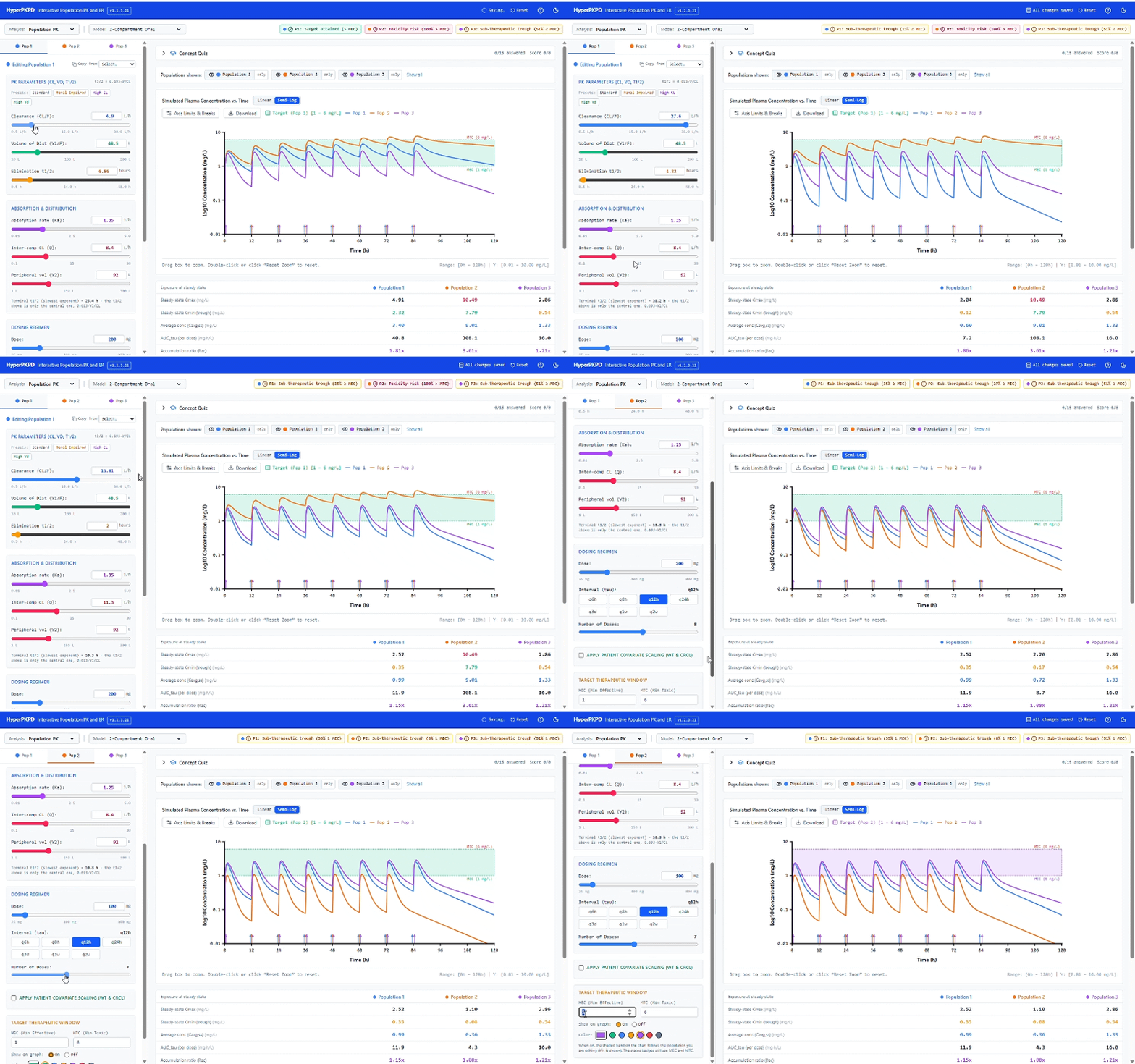
See pharmacokinetics and exposure–response move. Drag a slider, watch three populations diverge, and understand why. It runs entirely in your browser: no sign-up, no uploads, nothing to install.

  • 1-, 2- and 3-compartment oral and IV models, plus full TMDD (Mager–Jusko)
  • Five exposure–response models, with the concentration needed for a target effect solved for you
  • True steady-state exposure table: Cmax,ss, Cmin,ss, Cavg,ss, AUC and accumulation
  • 89 quiz questions with worked explanations; installable, offline, light and dark themes

An educational tool, not validated for clinical decision-making, dose selection or regulatory work.

Screen recording of the Tutor: moving a slider changes the concentration-time curves of three populations

Models

Population PK1-, 2-, 3-compartment oral and IV bolus; TMDD, 1- and 2-compartment
Exposure–responseLinear, log-linear, Emax, sigmoidal Emax (Hill), hockey-stick
Quizzes38 PK and 51 exposure–response questions
PrivacyNo backend; calculations stay in your browser

nlmx

Complete NCA/PK/PD/ER software that talks with you

From the raw dataset to the final report, without NONMEM, in a single offline program of about 30 MB with nothing else to install. nlmx reads NONMEM datasets and control streams directly and covers every step of an analysis.

  • Initial estimates, structural screening (1-, 2-, 3-compartment, TMDD, transit absorption) and fitting with FO, FOCE, FOCE-I, Laplace and SAEM
  • Covariate selection from a base model fitted with nlmx or NONMEM, so NONMEM is never required
  • VPC / pcVPC / NPC, forest plots, study simulation, sample size and power, and exposure–response

Covariate-selection results are recommendations: confirm every retained relationship with a full model fit before inference or submission.

Releasing December 10, 2026

--days
--hours
--min
--sec

Workflow

buildautoinit, screen, fit
covariatescov, forest
evaluatevpc
simulatesims, generate, power
responder

Covariate engines

frozenDoes the data push each candidate coefficient away from zero at the base solution?
posteriorWhich covariates repeatedly explain between-subject variability across draws and resamples?
bothWhere do the two lines of evidence agree?

Details

version4.2.1
runs onWindows, macOS, Linux; no NONMEM or network needed
licenceCC BY-ND 4.0

Push the boundary of pharmacometric software

We close the gap between the sophistication of modern pharmacometrics and the tools available to practitioners. Better software means better science, faster decisions, and safer medicines.

  • 01
    Advance modeling capability Deliver engines and methods that keep pace with the scientific questions pharmacometricians are asked to answer.
  • 02
    Improve everyday workflows Remove friction from data handling, model building, diagnostics, and communication of results.
  • 03
    Remain open and extensible Build in the open so the community can inspect, trust, and learn from the tools they rely on.

Built in the open, for the community

HyperPKPD tools are developed in the open on GitHub. Issue reports and scientific collaboration are welcome. nlmx and data-obfuscator are authored by Obinna (Obi) Obianom and licensed under CC BY-ND 4.0: use and share them unmodified, with credit. Transparent methods and reproducible tools are foundational to trustworthy pharmacometrics.

Frequently asked questions

What is HyperPKPD?

HyperPKPD is a set of free pharmacometrics tools for pharmacometricians, clinical pharmacologists and data scientists: nlmx for population PK/PD analysis, data-obfuscator for masking NONMEM-style datasets before sharing, and the Tutor for learning pharmacokinetics and exposure–response interactively.

Does nlmx replace NONMEM?

nlmx needs no NONMEM, no network and no other software at run time. It reads NONMEM datasets and control streams directly and fits models with FO, FOCE, FOCE-I, Laplace and SAEM. Its covariate selection starts from a completed base model, fitted either with nlmx or with NONMEM, so NONMEM is never required. Covariate-selection results are recommendations: confirm every retained relationship with a full model fit before using it for inference or submission.

Is it safe to use data-obfuscator on real study data?

data-obfuscator runs offline as a single program with no network code, so your data never leaves your machine. It recodes identifiers, shifts dates and can rescale covariates while leaving doses, observations, times and event flags intact. It is not formal anonymisation and not encryption, so review its warnings and keep the private keymap file to yourself.

Does the PK/PD Tutor upload or store my inputs?

No. The Tutor has no backend: calculations run in your browser and nothing leaves your device. Your settings are kept in your browser only so the app can restore them on reload. It is an educational tool and is not validated for clinical decision-making, dose selection or regulatory work.

Which platforms are supported?

nlmx and data-obfuscator are native programs for Windows, macOS and Linux. The Tutor works in current versions of Chrome, Edge, Safari and Firefox, and can be installed as an app and used offline.

What licence are nlmx and data-obfuscator under?

Both are licensed under Creative Commons Attribution-NoDerivatives 4.0 International (CC BY-ND 4.0). You may use, copy and share them unmodified, including commercially, with credit and a link to the licence. Distributing modified versions requires the author's permission.

Start with the tools that fit your workflow

Try the PK/PD Tutor in your browser, mask a dataset with data-obfuscator, or run your next analysis with nlmx.